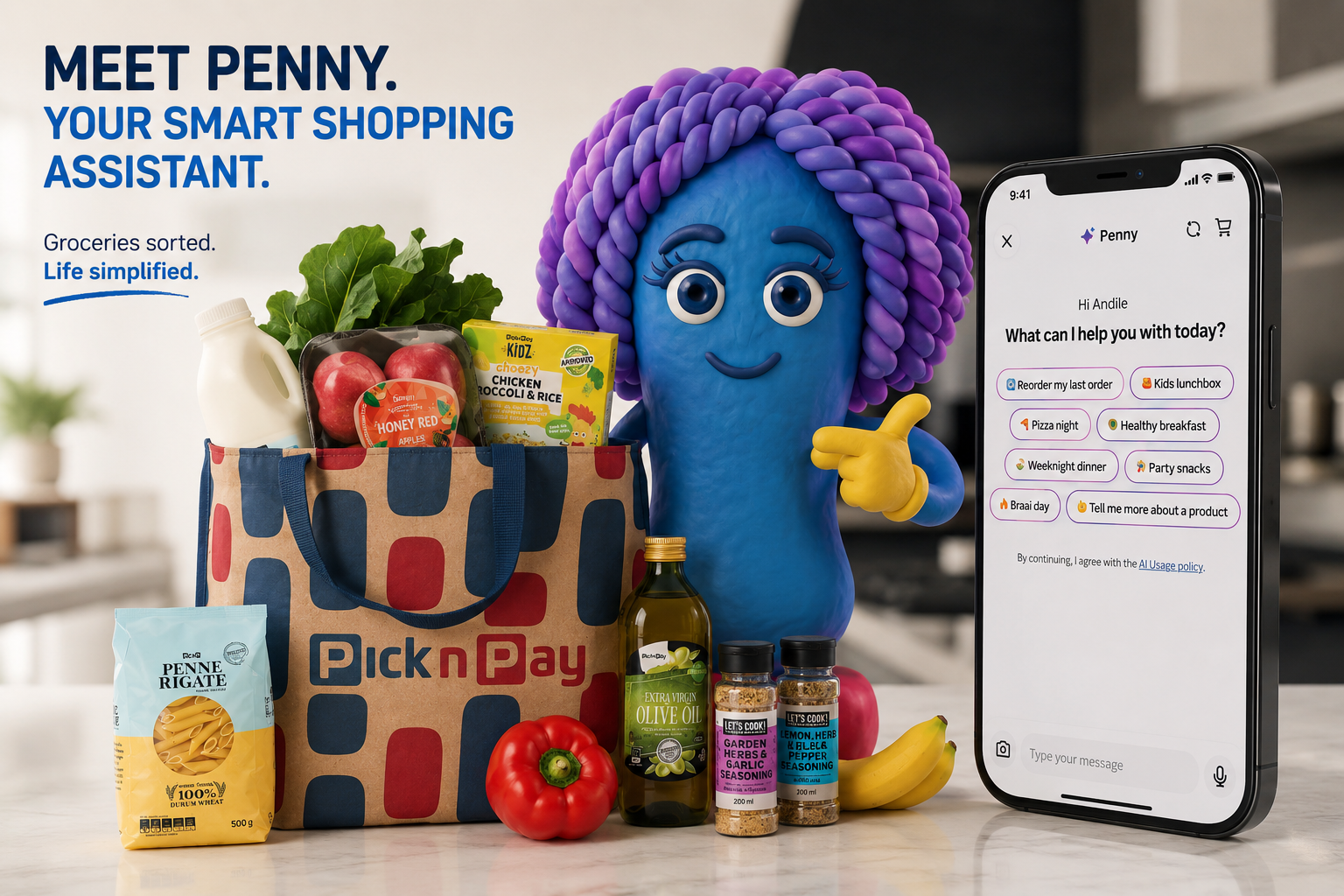
Pick n Pay has entered South Africa’s escalating contest for digital grocery shoppers, launching an artificial intelligence assistant named Penny on its asap! delivery platform in a move that signals how retail competition is shifting from delivery speed towards machine-driven personalisation.
The tool, unveiled in Johannesburg and available on the latest version of the asap! app, lets shoppers build a basket by speaking, typing or uploading a photograph, rather than trawling through category pages and search bars. Built on Google’s Gemini models, Penny can interpret a handwritten shopping list, identify ingredients from a fridge photo and generate a weekly meal plan within a stated budget and set of dietary preferences, automatically loading the resulting items into a basket.
Pick n Pay’s omnichannel retail executive, Enrico Ferigolli, framed the launch as evidence that the industry’s next competitive frontier lies beyond logistics. Where retailers spent recent years racing to shorten delivery windows, the emphasis has now turned to stripping effort out of the shopping process itself. Ferigolli argued that South Africa’s online grocery sector has become one of the most sophisticated in the world, leaving little room for complacency among incumbents.
READ – Pick n Pay Gets Market Confidence Boost
The rollout follows Checkers Sixty60’s introduction of its own assistant, Pixie, in April, developed by ShopriteX and built to learn from a customer’s purchase history and Xtra Savings loyalty data to anticipate needs before a search even begins. Shoprite has paired that tool with its AI-enabled Smart Trolley, extending automation from the app into the physical aisle. Together, Penny and Pixie mark the clearest sign yet that South Africa’s two largest grocery groups view predictive, conversational commerce as the next battleground, rather than price promotions or delivery fees alone.
The stakes are considerable. South Africa’s online grocery market is projected to reach roughly R80 billion by 2026, with some forecasts placing it between R120 billion and R130 billion by 2029, according to Statista’s Digital Market Outlook. Grocery e-commerce expanded at a compound annual rate of around 47% between 2017 and 2024, though it still accounts for under 2% of total grocery retail spend, leaving substantial headroom for growth. The number of South African e-commerce users is expected to nearly double, from 11.7 million in 2025 to 21.5 million by 2029, a trajectory that helps explain why retailers are investing heavily in tools designed to keep shoppers within a single app rather than comparing prices elsewhere.
Market Snapshot
| Metric | Figure |
|---|---|
| SA online grocery market value (2026 est.) | R80 billion |
| Projected value by 2029 | R120–130 billion |
| Grocery e-commerce CAGR, 2017–2024 | 47% |
| Online share of total grocery retail (2024) | Under 2% |
| SA e-commerce users, 2025 → 2029 | 11.7m → 21.5m |
Google South Africa’s country director, Kabelo Makwane, said the shift reflects changing search behaviour, with consumers now issuing detailed, conversational requests rather than single-word queries, forcing retailers to build systems that grasp intent rather than keywords. He noted that rising customer expectations and rapid technological change are placing retailers under pressure to match the sophistication consumers now expect from digital tools.
READ – Pick n Pay Raises R4.7bn via Boxer Share Sale
Ferigolli said Penny was made possible by a full rebuild of Pick n Pay’s digital infrastructure completed last year, which he described as giving the group the technical foundation to deploy new features more quickly. The wider contest also follows Amazon’s launch of Prime in South Africa in June, adding further pressure on established grocery chains to differentiate through technology rather than price alone.
As adoption of AI shopping tools deepens across the sector, the competitive question is narrowing: rather than which retailer can deliver fastest, the industry is increasingly asking which platform’s assistant can most accurately anticipate what a customer wants before they ask for it.