

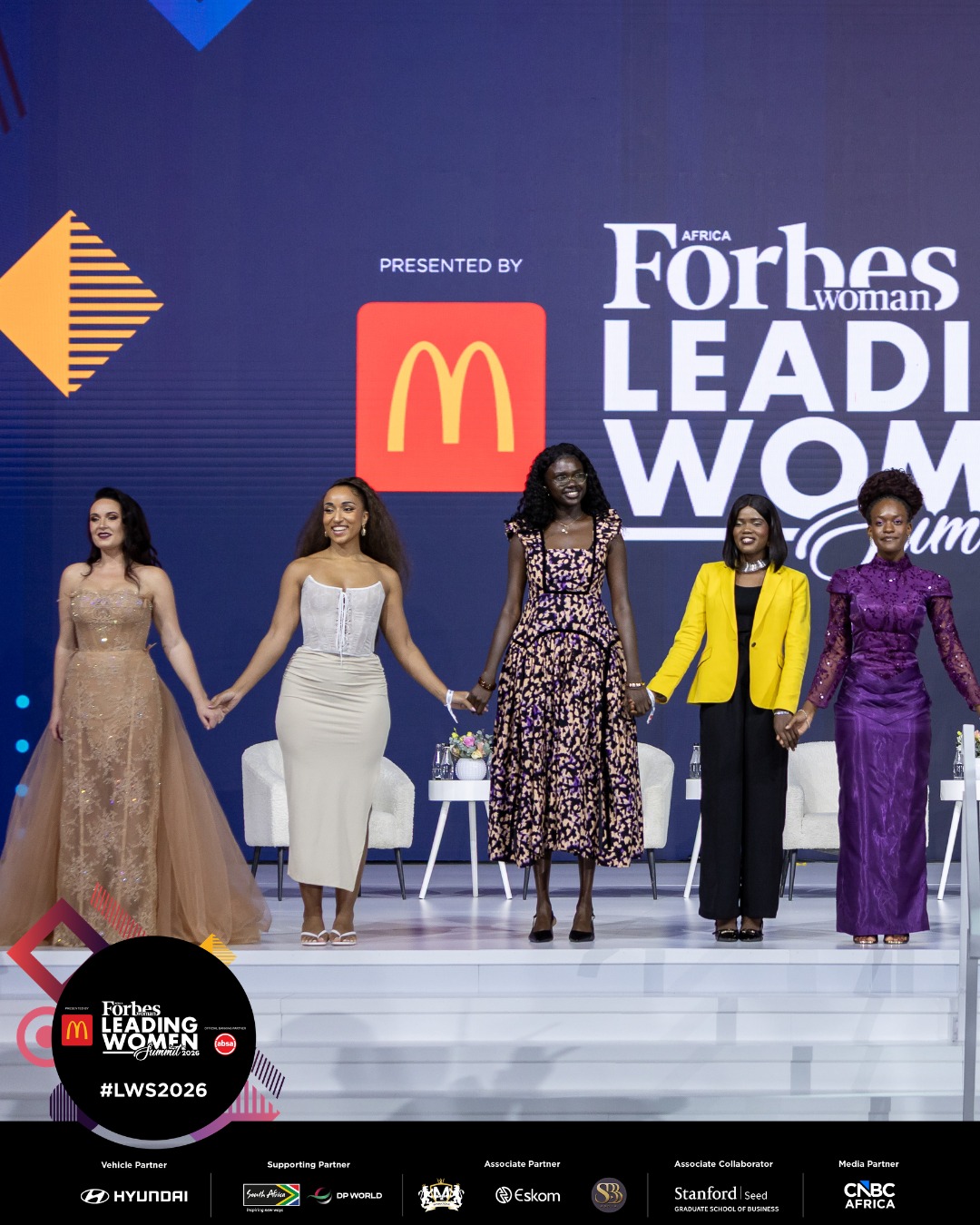
The Sandton Convention Centre has transformed into a concentrated hub of influence as Forbes Africa convened its annual Leading Women Summit. What unfolded was not simply a gathering of prominent women, but a deliberate convergence of capital, policy, and leadership – an ecosystem where Africa’s present and future economic drivers were in active dialogue.
There was a distinct sense that this was less about visibility and more about positioning. Across the rooms, conversations carried the weight of industries, countries, and institutions. Figures such as Dr. Precious Moloi-Motsepe moved seamlessly between philanthropy and enterprise, embodying a model of influence that extends beyond balance sheets into long-term societal impact. Equally significant was the presence of Judith Suminwa Tuluka, whose role as the DRC’s first female Prime Minister signals a broader continental shift—one where governance itself is being redefined through more inclusive leadership structures.
From East Africa, Roman Tesfaye brought a different dimension of leadership—one rooted in advocacy and social transformation. Her recognition later that evening with a Lifetime Achievement Award was not merely ceremonial; it reinforced the economic value of sustained social investment, particularly in areas often excluded from traditional growth metrics. Alongside these figures, the presence of Yvonne Chaka Chaka served as a reminder that influence is not confined to boardrooms or political office. Cultural capital, when mobilized effectively, becomes a powerful tool in shaping both identity and economic opportunity.
The Nigerian delegation, notably strong in both number and presence, underscored West Africa’s growing strategic weight within the continent. Their participation reflected more than attendance—it pointed to Nigeria’s expanding role as a driver of entrepreneurship, capital formation, and cultural export. In many ways, their presence reinforced a quiet but undeniable truth: Africa’s economic future will be shaped not by isolated national efforts, but by interconnected regional momentum.
The institutional backing of the summit further revealed where priorities are aligning across sectors. Forbes continues to act as both a mirror and a megaphone, shaping narratives that influence how capital perceives Africa. Stanford Universitysignaled the importance of intellectual infrastructure and global academic integration, particularly as African leadership becomes increasingly embedded within international innovation ecosystems. Meanwhile, Eskom represented a more complex but essential layer of economic reality—energy. Its inclusion served as a reminder that without stable infrastructure, even the most progressive leadership conversations remain constrained.
In parallel, African Fashion International (AFI | Nala House) highlighted the growing legitimacy of the creative economy as a serious economic sector. Fashion, often relegated to the periphery, is increasingly understood as a driver of manufacturing, exports, and cultural diplomacy. McDonald’s brought into focus the mechanics of scale—employment, supply chains, and franchise ecosystems—illustrating how large corporations contribute to economic participation at multiple levels. Financial systems were represented by Absa Group, whose role in enabling access to capital remains fundamental to unlocking both entrepreneurial and institutional growth. At the same time, Hyundai Motor Companyreflected the industrial and mobility ambitions of a continent in transition, where urbanization and infrastructure development are rapidly reshaping demand.
What distinguished the summit, however, was not only the presence of established leaders but the intentional inclusion of emerging ones. Young achievers across STEM, fashion, education, and non-governmental sectors were not positioned as future participants—they were integrated into the present conversation. This matters because economic transformation is not only about current leadership; it is about how effectively a system builds and accelerates its pipeline of talent. By creating proximity between experience and potential, the summit effectively shortened the distance between ambition and execution.
This layered representation speaks directly to the economics of human capital. Women in STEM signal entry into high-value, globally competitive industries. Those in the creative sectors reflect Africa’s growing influence in shaping global culture and consumption patterns. NGO leaders, often closest to grassroots realities, bring critical insights into implementation, governance gaps, and social resilience. Together, they form a more complete picture of what sustainable growth requires—an integration of hard infrastructure, soft power, and social systems.
At a strategic level, the summit functioned as a platform for alignment. It aligned narratives, shifting the perception of African women from participants to architects of economic change. It aligned networks, creating spaces where relationships could evolve into partnerships and, ultimately, into transactions. And perhaps most importantly, it aligned capital—across industries and geographies—around the understanding that gender inclusion is not a peripheral issue but a central economic driver.
In this context, the Forbes Leading Women Summit becomes more than an event; it becomes an instrument. An instrument through which Africa is actively shaping how it is seen, how it invests, and how it leads. The presence of leaders from across the continent—from the Democratic Republic of the Congo to Nigeria to Ethiopia—reinforced a collective momentum, one that is less about catching up and more about defining new terms of engagement.
What emerged from Sandton that day was not just inspiration, but intent. A clear indication that Africa’s growth story is being written with increasing coordination, and with women at the center of that narrative. Because when leadership expands to include those historically at the margins, the result is not incremental change—it is structural transformation.