
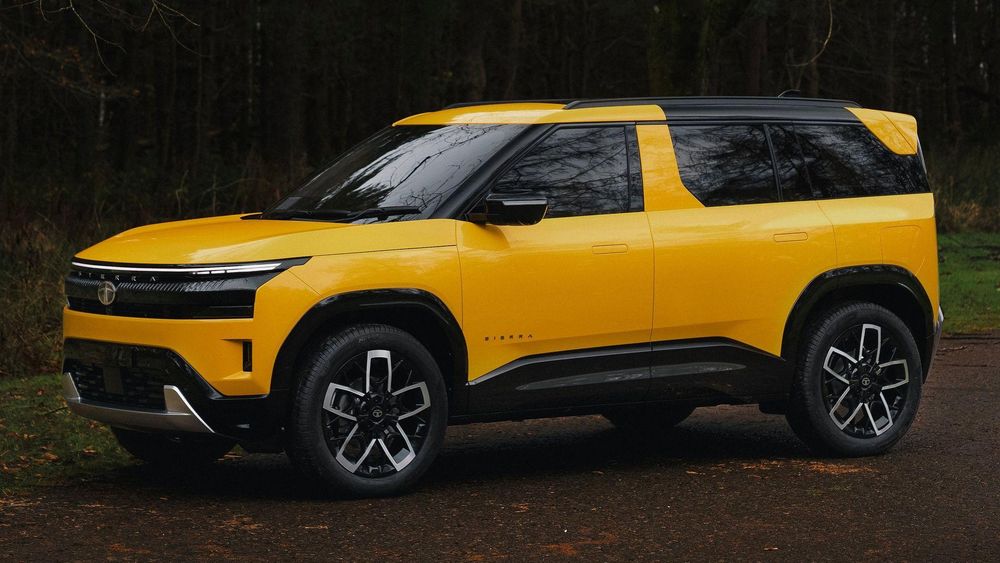
Tata Motors, India’s third-largest passenger vehicle manufacturer, has unveiled the long-awaited Sierra SUV, a modern reincarnation of its 1990s icon designed to intensify rivalry in the mid-size segment against established contenders such as Hyundai’s Creta and Maruti Suzuki’s Grand Vitara. Priced from an introductory Rs 11.49 lakh ex-showroom, the Sierra combines retro styling cues—like its distinctive Alpine window glasshouse—with cutting-edge features including a triple-screen dashboard, 5G connectivity and the slimmest LED headlamps in the Indian market at just 17 mm. Bookings open on 16 December 2025, with deliveries commencing in mid-January 2026, positioning the vehicle to capitalise on a segment that grew 12 per cent year-on-year in FY2025 to over 5.5 lakh units, as reported by Autocar Professional, where SUVs now account for more than 50 per cent of total passenger vehicle sales amid urbanisation and rising disposable incomes.
The Sierra’s launch underscores Tata’s aggressive expansion strategy in a passenger vehicle market valued at Rs 18.5 lakh crore in 2025, projected to expand at a compound annual growth rate of 8.5 per cent through 2030. Built on a fresh architecture and powered by Tata’s debut 1.5-litre turbocharged direct-injection petrol engine—producing up to 170 bhp and 280 Nm of torque—the model promises class-leading performance while adhering to higher ethanol blend compatibility for sustainability. Safety remains a hallmark, with standard six airbags, electronic stability control and hill assist, aligning with Tata’s track record of securing five-star ratings from Global NCAP and Bharat NCAP. According to Hindustan Times, the Sierra aims for a 20-25 per cent slice of the mid-size SUV pie, a bold target in a space where Hyundai’s Creta commands 31.6 per cent share after selling 1,94,871 units in FY2025, up from 29.1 per cent the prior year, buoyed by its facelifted design and new electric variant.
Tata’s resurgence in recent years has been remarkable, with its passenger vehicle market share climbing to over 13 per cent by September 2025 from a mere 5 per cent in 2019, driven by a safety-first ethos and a commanding presence in electrics. As India’s leading EV producer, Tata holds 38 per cent of the electric passenger vehicle market through October 2025, having sold over 73,000 units year-to-date despite a dip from 59 per cent in 2024, as competitors erode its edge. The Sierra’s internal combustion engine debut will be complemented by an electric iteration in early 2026 on the acti.ev platform, offering more than 500 km range and all-wheel-drive options, further broadening Tata’s portfolio amid a national EV sales surge of 68 per cent year-on-year to 119,332 units in the first seven months of 2025.
Yet, the competitive landscape is fiercer than ever, with Mahindra & Mahindra vying aggressively to unseat Hyundai from second place in overall passenger vehicles, where Maruti Suzuki’s arm maintains a dominant 42 per cent share. Mahindra’s EV sales rocketed 343 per cent year-on-year in May 2025 to 2,632 units, capturing 22.6 per cent market share by August, thanks to stylish launches like the BE 6 and XEV 9e, while JSW MG Motor—backed by China’s SAIC—doubled its EV footprint to 30 per cent with models such as the Windsor. Hyundai, meanwhile, reinforces its mid-size stronghold through value-driven offerings, with the Creta’s sibling, the Maruti Grand Vitara, posting 1,23,946 units in FY2025—a modest 2 per cent rise—despite a 26 per cent year-on-year dip in October to 10,409 units amid festive demand fluctuations.
For Tata, the Sierra represents more than a product refresh; it signals a pivotal growth chapter, with plans for additional launches to sustain momentum in a market where mid-size SUVs like the Creta, Seltos and Grand Vitara collectively outsold rivals by 15 per cent in the April-August 2025 period. As economic tailwinds such as improved credit access and infrastructure investments propel SUV penetration—now at 52 per cent of new car buys—Tata’s focus on innovation, from IP-based telematics to a panoramic sunroof, positions the Sierra as a versatile contender for urban professionals and families alike. In an era where every second vehicle sold in India is an SUV, this revival could tip the scales, blending heritage with the forward-thinking drive needed to reclaim ground from Hyundai and Suzuki in one of the world’s fastest-expanding auto arenas.