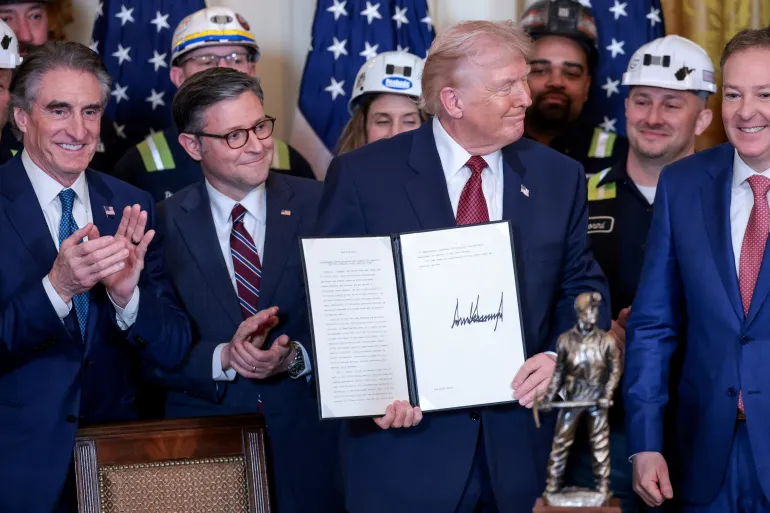
United States President Donald Trump has instructed the Pentagon to procure electricity from coal-fired plants, representing his administration’s most recent initiative to support the fossil fuel sector despite ongoing concerns about climate change and economic viability.
In the executive order issued on Wednesday, Trump required the US Department of Defence to establish long-term contracts with coal power facilities and to emphasise the maintenance and strategic application of coal energy resources. The directive omitted specifics regarding the volume of energy to be acquired or the associated financial conditions.
At a White House gathering with coal sector leaders and workers, Trump highlighted the contributions of the industry to heating residences, powering manufacturing, and transforming resources into national prosperity. He also revealed that the US Department of Energy would allocate 175 million dollars for enhancements to six coal plants located in North Carolina, Ohio, West Virginia, Kentucky, and Virginia. Trump commended the coal workers present as essential to sustaining the nation’s operations.
Coal output in the United States has experienced a prolonged downturn due to intensifying rivalry from natural gas and renewable sources such as wind, hydropower, and solar. As reported by Al Jazeera, production halved between 2008 and 2023, reaching 578 million tonnes that year. According to US Energy Information Administration, output further declined by 11.3 percent in 2024 to 512.5 million short tonnes, with consumption dropping to 410.9 million short tonnes. Preliminary data for 2025 indicate a slight rebound in production early in 2026, up 2.2 percent year-to-date compared to the prior year, partly driven by an 11 percent increase in coal-fired generation amid elevated natural gas prices.
In 2023, coal constituted approximately 16 percent of US energy production, trailing natural gas at 43 percent and renewables at 21 percent. By 2025, coal’s share had diminished to 15 percent of electricity generation, reflecting ongoing market shifts.
A 2023 study by Energy Innovation determined that 99 percent of US coal facilities cost more to operate than replacing them with renewable options. Updated analyses in 2025 reaffirm this trend, with levelised costs of energy for coal ranging from 69 to 169 dollars per megawatt-hour, compared to 29 to 92 dollars for utility-scale solar and 27 to 53 dollars for onshore wind.
Trump has advocated for the resurgence of what he terms efficient and environmentally sound coal as vital for enhancing domestic production and securing leadership in artificial intelligence, notwithstanding its reduced market edge and role in emitting greenhouse gases that exacerbate climate change.
Having withdrawn the United States from the Paris climate agreement and dismissed established scientific views on rising temperatures as misleading, Trump proclaimed an energy crisis on his inaugural day in office to avert the shutdown of outdated coal plants. Since then, the US Energy Department has compelled at least five facilities to prolong their service past intended closure dates.
On the same day, the Tennessee Valley Authority, the nation’s premier public utility, decided to extend the operational life of two coal plants previously slated for decommissioning by 2035. This followed the addition of four Trump nominees to its board last month, after the dismissal of three members appointed by former President Joe Biden.