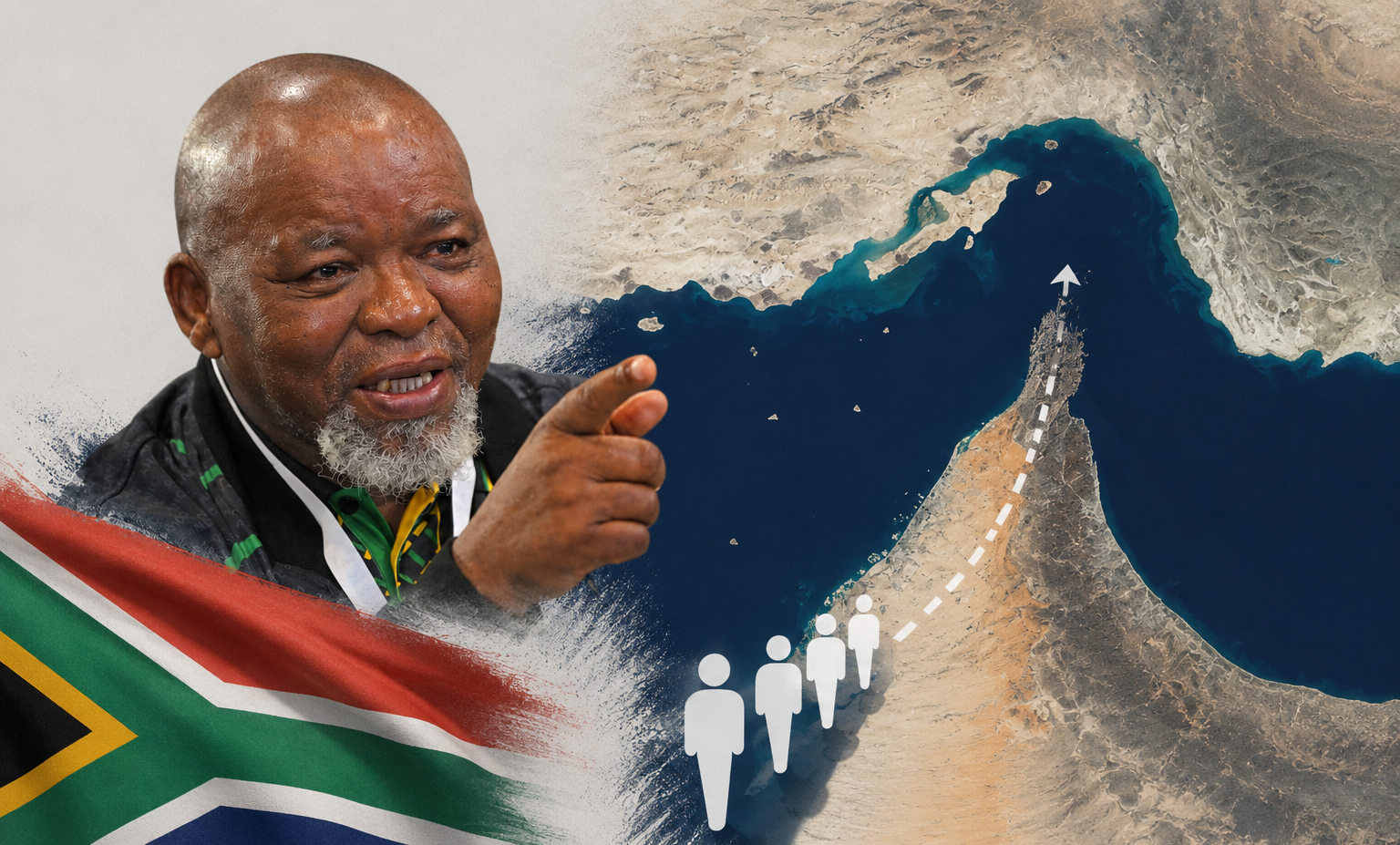
Mineral and petroleum resources minister Gwede Mantashe has announced that South Africa will send a government delegation to the Strait of Hormuz to assess the geopolitical dynamics disrupting global oil supply chains. Addressing the National Assembly during his department’s budget vote on Tuesday, Mantashe framed the planned visit as an effort to gain first-hand understanding of how a narrow waterway — barely 33 kilometres wide at its narrowest point — continues to hold the global energy system hostage.
The strait, which separates the Persian Gulf from the Gulf of Oman, is the single most critical chokepoint in global oil trade. According to the International Energy Agency, nearly 15 million barrels per day of crude oil passed through the strait in 2025, representing approximately 34% of global crude oil trade. The current conflict between the United States, Israel, and Iran has severely disrupted that flow.
READ – President Ramaphosa Establishes Task Team to Tackle Fuel Crisis
Iran has demonstrated both the willingness and the capability to harass and damage commercial vessels transiting the waterway, having attacked at least 22 vessels since hostilities escalated in early 2026. The Brookings Institution described the resulting supply shortfall as larger than those of the 1973 and 1979 oil crises combined.
For South Africa, the consequences are acute. The country already relied on imports for approximately 61% of its petroleum product supply in 2023 — up from 22% just four years earlier — following the closure of the Sapref refinery in Durban and the effective scaling down of Natref in Sasolburg. Mantashe acknowledged that domestic refining capacity now covers only 40% of national fuel requirements, leaving the country structurally exposed to external supply shocks of precisely the kind now unfolding in the Middle East.
Despite the disruption, Mantashe provided assurances that South Africa had secured sufficient fuel supplies for the foreseeable future. He confirmed there would be no shortage of petrol or diesel at filling stations, though he cautioned that prices would remain elevated. The government has been partially shielding consumers through a temporary R3 per litre reduction in the fuel levy, which Finance Minister Enoch Godongwana extended from April to June 2026 at an estimated cost to the fiscus of R17.2 billion. Mantashe was explicit that this relief was a short-term measure and not a structural solution.
The minister used the occasion to press the case for accelerating the South African National Petroleum Company (SANPC) Bill, which is currently before parliament. The proposed state entity would replace the upstream-focused PetroSA and enable direct state participation in oil and gas exploration and production, as envisioned under the Upstream Petroleum Resources Development Act.
Mantashe argued that the country’s dependence on imported refined products was neither sustainable nor justifiable given South Africa’s own petroleum potential, and that expanding domestic refining capacity and developing an upstream industry remained the only durable solution.
READ – South Africa in Talks to Secure Alternative Fuel Supply
On the mining sector, Mantashe acknowledged that high electricity tariffs were placing severe operational pressure on mining companies, particularly in the ferroalloy sector. South Africa’s ferrochrome producers had been paying as much as 135.82 cents per kilowatt-hour by the end of 2025, a level that prompted smelter closures and emergency negotiations with Eskom.
The utility subsequently agreed to a discounted five-year negotiated pricing arrangement for the sector, but the minister conceded that broader beneficiation ambitions could not be realised until the electricity cost problem was resolved structurally.
Mantashe reported progress on the critical minerals and geoscience mapping programme. The Council for Geoscience has increased national onshore mapping coverage from below 5% in 2019 to a cumulative 20% in the 2025/26 financial year. The Junior Mining Exploration Fund, jointly capitalised at R400 million by the department and the Industrial Development Corporation, has already funded 13 projects.
Anglo American’s formal commitment of R600 million to the fund in February 2026 lifted the total fund size to R1 billion. The Public Investment Corporation has separately made R1.35 billion available to function as a continuation fund for the project pipeline emerging from the JMEF.
The debate drew sharp opposition from the Democratic Alliance’s mining spokesperson, James Lorimer, who cited Bureau of Economic Research findings that South Africa’s share of global mineral exploration spending had collapsed from nearly 5% in 2004 to less than 1% today.
In 2024, South Africa spent just $43 million on exploration — a negligible figure by global standards. Lorimer attributed the decline to policy and regulatory constraints rather than geological exhaustion, pointing specifically to persistent uncertainty over broad-based black economic empowerment targets and the successive iterations of the Mining Charter. The Fraser Institute’s 2025 survey placed South Africa 57th out of 68 jurisdictions in its Investment Attractiveness Index, an improvement from 68th in 2024 but still firmly in the bottom tier.
Lorimer argued that requiring 30% BEE ownership before a project begins constituted a tax on capital that directly suppressed investment. Mantashe strongly rejected that framing, reaffirming the government’s commitment to transformation in the sector, echoing remarks made by President Cyril Ramaphosa in the National Assembly the previous week. The Solidarity Research Institute released a report on Tuesday concluding that the mining industry had contracted as a direct result of poor policy, including transformation requirements.
Key Indicators: South Africa’s Petroleum and Mining Landscape
| Indicator | Metric | Source / Period |
| Domestic refining capacity (% of need) | 40% | Mantashe, May 2026 |
| Petroleum import dependency | ~61% of supply | 2023 data |
| Fuel levy relief cost to fiscus | R17.2 billion | April–June 2026 |
| Strait of Hormuz daily oil transit | ~15 million barrels/day | IEA, 2025 |
| SA share of global mineral exploration | <1% | BER, 2024 |
| SA share of global mineral exploration (peak) | ~5% | BER, 2004 |
| JMEF total fund size (post-Anglo commitment) | R1 billion | February 2026 |
| PIC continuation fund for exploration | R1.35 billion | 2026 |
| CGS onshore mapping coverage (FY2025/26) | 20% (cumulative) | Dept. MPRR, 2026 |
| Fraser Institute IAI ranking (2025) | 57th of 68 | Fraser Institute, 2026 |