
The latest liquidation statistics released by Statistics South Africa show a welcome decline in business liquidations during July 2026, but the data should not be interpreted as a sign that financial pressures facing South African businesses have eased significantly.
According to the latest figures, a total of 239 companies and close corporations were liquidated in July 2026, representing a 23.2% decrease compared to the 311 liquidations recorded in July 2025. The number of liquidations also declined by 13.9% in the three months ended July 2026 compared to the corresponding period last year, while year-to-date liquidations were down 4.9%.
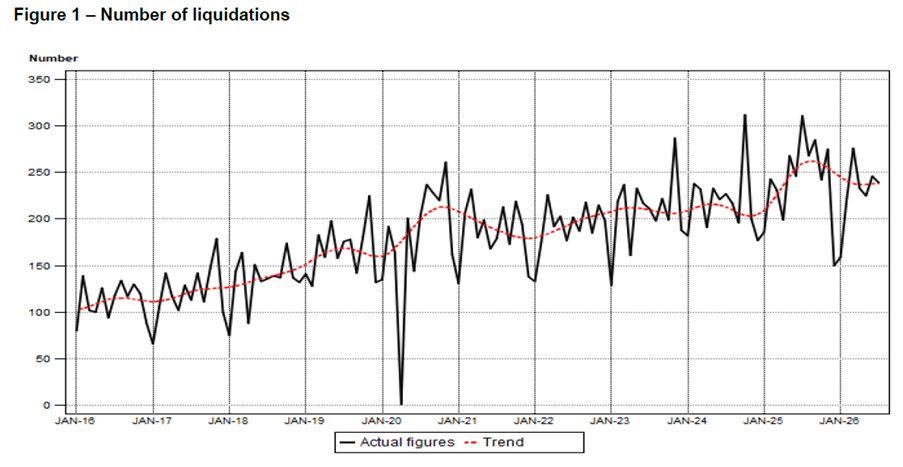
Source: Statistics South Africa
While the trend is encouraging, businesses continue to operate in an environment characterised by weak economic growth, increasing cost pressures, infrastructure challenges and low consumer confidence.
“The decline in liquidations is positive, but it does not mean the operating environment is less risky. Many businesses remain under pressure, particularly where cash flow is constrained by slow-paying customers, rising operating costs and weak demand,” says Aroni Chaudhuri, Chief Economist for Africa Coface.
The latest data shows that the finance, insurance, real estate and business services sector continued to account for a significant proportion of liquidations during July, followed by the trade, catering and accommodation sector.
At the same time, insolvency statistics released by Statistics South Africa in August indicate that financial distress remains widespread among individuals and partnerships. A total of 143 insolvencies were recorded in July 2026. Although this represents an 11.8% year-to-date decline, the figures show that the level of unpaid debt in the economy remains high overall.
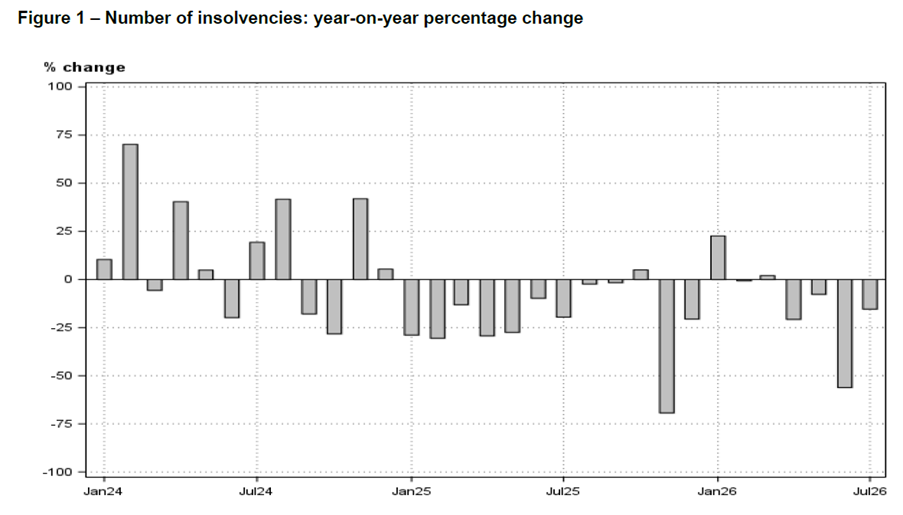
Source: Statistics South Africa
“Since the statistical revision of liquidation data in April 2026 and the reintroduction of insolvency statistics in June 2026, these two variables can be analysed together as indicators of broader economic conditions. With interest rates increasing, we can also expect insolvencies to increase in the coming quarters,” explains Chaudhuri.
At the global level, according to recent research from Coface, business insolvencies increased by 12% in early 2026, driven largely by a 22% increase in North America, prompting Coface to revise its global insolvency forecast upward to 6% growth in 2026. The global rise is being fuelled by geopolitical tensions, elevated financing costs, persistent inflationary pressures and weaker economic activity.

According to Coface, sectors most vulnerable to insolvency globally include construction, chemicals and textiles, while high borrowing costs continue to place pressure on highly leveraged businesses and SMEs.
“South African businesses are operating in the same global environment. While local liquidation and insolvency trends have improved in recent months, companies will feel the impact of deteriorating economic conditions in the coming months, as the impact of price pressures and interest rate hikes generally materialize with a lag,” says Chaudhuri.
For many businesses, unpaid debt remains one of the most significant threats to sustainability. Effective credit risk management can help companies identify potential risks earlier, make informed trading decisions and protect revenue streams in an uncertain economic environment.
As economic conditions remain fragile both locally and internationally, Coface believes businesses should continue to focus on proactive risk management measures to strengthen resilience and support sustainable growth.