
Mr Price Group, South Africa’s largest listed value fashion retailer, grew revenue to R42.7 billion in the financial year to end-March 2026, posting operating profit above R6 billion for the first time. Yet the results, announced on Friday, came with a notable warning: online gambling is now competing directly with retailers for the same rand in the consumer’s pocket.
CEO Mark Blair acknowledged that while macro conditions are moving in a more favourable direction — lower inflation, a sequence of interest rate cuts, and a modest improvement in disposable incomes — South Africa’s discretionary retail sector has not been a direct beneficiary. He pointed to online gambling as one of several forces competing for consumer spending, a comment that, in the context of published industry data, carries considerable weight.
READ – Pick n Pay Boss Calls for Ban on Online Gambling Advertising
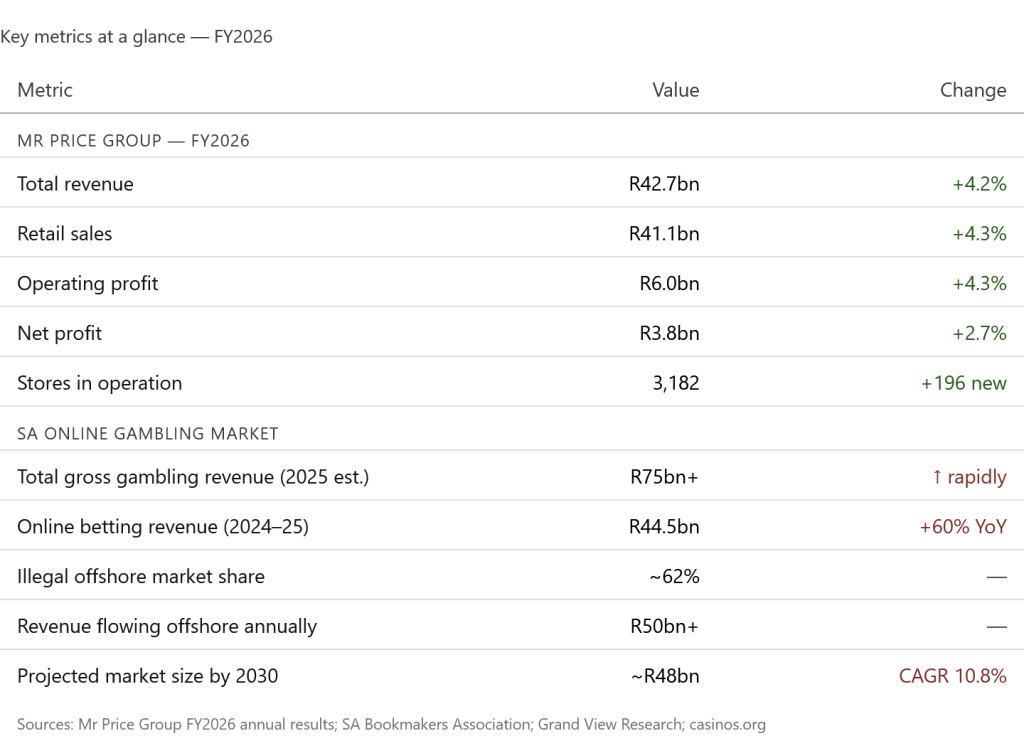
The scale of the online gambling sector in South Africa is striking. According to the South African Bookmakers Association, illegal offshore operators account for approximately 62% of the country’s online gambling activity, with more than R50 billion in gross gambling revenue leaving the country annually. The broader South African gambling market is estimated to have generated in excess of R75 billion in gross gaming revenue in 2025, with the online component growing at roughly 10.8% per annum. Online betting revenue specifically surged by around 60% year-on-year in 2024-25, reaching an estimated R44.5 billion — dwarfing traditional casino revenues of R16.6 billion. Approximately 81% of all bets are now placed via smartphones and tablets.
For retailers operating in the discretionary space, the concern is structural. When a consumer chooses to place R500 on a sports betting app rather than spend it on clothing, homeware, or footwear, that rand is gone from the retail economy — frequently to an unlicensed offshore operator. The two-pot pension withdrawal system, which temporarily boosted consumer spending in late 2024 and early 2025, has since wound down, removing what was an artificial floor under retail sales volumes.
READ – Research – Workers Risking Salaries to Gamble
Mr Price navigated this environment with more success than several of its peers. Revenue grew 4.2% to R42.7 billion over the financial year to end-March, with retail sales rising 4.3% to R41.1 billion and operating profit climbing 4.3% to just above R6 billion for the first time. The group opened 196 stores during the year, expanding its footprint to 3,182 stores across 15 trading chains. By contrast, rival TFG reported weaker profits, shrinking margins, and continued losses in its international operations.
Blair’s value-focused model has been central to that outperformance. Mr Price Apparel remained the most shopped apparel retailer in South Africa according to the MAPS 2025 study, and leads what the company describes as the fashion-value matrix. In an environment where consumers are actively seeking cheaper alternatives, positioning at the affordable end of the market provides a degree of insulation — though not immunity.
The group also confirmed the completion of its acquisition of NKD, a German-based value fashion retailer operating under the Pegasus Group banner, which concluded after the financial year-end. The transaction costs were expensed in the FY2026 results, weighing on reported earnings. Mr Price described its immediate international priorities as consolidating the South African operation and executing on its NKD strategy, with potential expansion into a third international market placed on hold for the foreseeable future.
READ – Mr Price Doubles Down on R9.6bn Deal
Looking ahead, Blair flagged the escalation of the US-Iran conflict as a fresh source of macro uncertainty, noting that higher oil prices and fuel costs carry direct inflationary consequences for South African consumers who are already stretched. The group said it would enter the new financial year with caution, relying on its value positioning, store expansion pipeline, customer data capabilities, and loyalty programmes to sustain growth.
The online gambling question, however, is unlikely to recede. National Treasury released a discussion paper in late 2025 proposing a 20% national tax on online gambling gross gaming revenue — a move that could reshape the economics of the sector but does little in the near term to redirect consumer spending back towards retail. Until regulatory frameworks are sufficiently enforced to curb the flow of gambling revenue to offshore operators, South African retailers may find that the most formidable competitor they face is not another clothing chain — it is a betting app.