

A professional services report commissioned as part of a failed acquisition has placed Spar Group at the centre of a tax fraud controversy, adding regulatory and reputational strain to a JSE-listed retailer already deep in crisis.
According to Business Day, the BDO report, dated September 2025, was compiled on behalf of businessman Amaan Sayed, who was evaluating a purchase of Spar’s corporate-owned Bloed Street Tops store in Pretoria.
The report found unreliable financial information that did not reconcile with reported figures, and inflated gross profit that was inconsistent with underlying stock and sales. More seriously, the store was found to have underdeclared output sales and overdeclared input sales, shortchanging the South African fiscus — a direct violation of the VAT Act. The report also identified stock price manipulation and the rolling over of stock as mechanisms used to conceal losses.
The findings arrive at a moment of acute vulnerability for Spar. The group warned in late May that headline earnings were expected to fall by between 50 and 60 per cent for the 26 weeks to 27 March 2026, sending its share price down 16 per cent in a single session. That announcement followed a year in which the company had already haemorrhaged value. Shares in Spar tumbled to levels last seen in 2010 after a trading update in February 2026, with the stock losing more than half its value over the prior twelve months — making it, by that measure, the worst-performing large food retailer in South Africa.
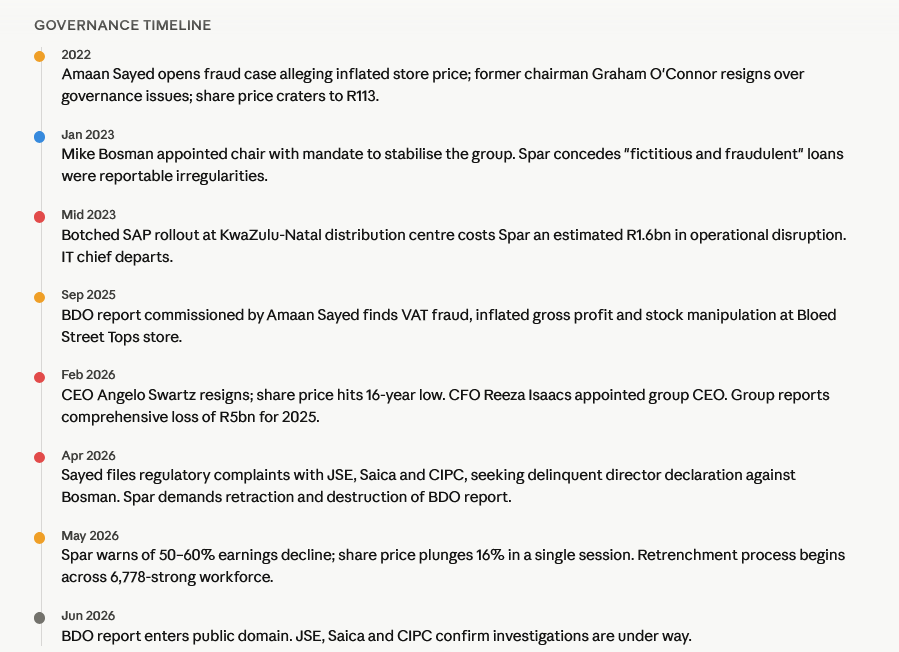
The governance backdrop is just as turbulent. The group reported a comprehensive loss of R5 billion for its 2025 financial year, and shareholders are still waiting for dividends. In February, chief executive Angelo Swartz announced his resignation, sending the share price down a further nine per cent, prompting the appointment of former Woolworths finance director Reeza Isaacs as group CEO. At the most recent AGM, 61 per cent of shareholders voted against the proposed executive pay policy, a sign of investor frustration that goes beyond financial performance.
The Bloed Street controversy connects directly to the figure nominally responsible for steadying the ship. Sayed’s regulatory complaints, filed with the JSE, the South African Institute of Chartered Accountants (Saica) and the Companies and Intellectual Property Commission (CIPC) in April, name interim executive chair Mike Bosman personally. The complaints allege that Bosman failed to discharge the governance duties required of both a chair of a listed company and a registered chartered accountant, and that a flawed stock formula applied across several corporate Spar and Tops stores in March 2025 artificially inflated opening stock figures, with VAT fraud arising from falsified supplier documentation extending well beyond the single store examined by BDO. The most severe outcome Sayed is seeking is a delinquent director declaration from the CIPC — a formal finding under the Companies Act that would bar Bosman from serving on any board.
Bosman is a figure who carries particular symbolic weight in the Spar story. He was appointed chair in early 2023 with a no-nonsense mandate to right the listing company after a governance implosion that had cratered the share price to R113 by the end of 2022. He oversaw management changes, a new board, and the group’s eventual exit from its loss-making Polish and Swiss operations. Under his watch, the group also had to manage the fallout from the botched rollout of the SAP enterprise resource planning system intended to upgrade the KwaZulu-Natal distribution centre — a project that cost Spar an estimated R1.6 billion in operational disruption. That KZN operation, which delivered three consecutive profitable months in February, March and April 2026, still requires further work to stabilise, according to the group itself.
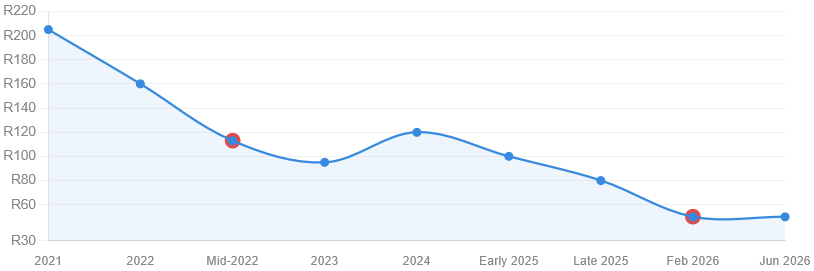
Share price trajectory — approximate (ZAR)
Spar’s response to the BDO allegations has been to contest both the scope of the findings and the motivations behind them. The group said its own internal review found no reportable irregularities and that the BDO report relates only to a single store. It characterised Sayed’s regulatory filings as motivated by his unsuccessful attempt to acquire the Bloed Street store, noting that the Spar Guild declined his retailer application citing poor credit history, prior debt write-offs and conduct said to have brought the brand into disrepute. Through its lawyers, Spar wrote to Sayed demanding that he retract his submissions to regulators and confirm the destruction of all material relating to the BDO report, including the report itself, and warned of defamation proceedings.
Sayed rejected those demands outright. His lawyers at Petker & Associates Incorporated argued that reporting suspected irregularities to regulators cannot constitute defamation and that the complaints were grounded in findings from an independent audit. They also opposed the request to destroy the documentation, describing the material as relevant to potential wrongdoing.
Sayed’s history with Spar is longer and more acrimonious than the current dispute suggests. In December 2022, he opened a criminal fraud case against the company’s leadership, alleging that Spar had deliberately inflated the price of a Johannesburg superstore he purchased in 2018, making its balance sheet appear healthier than it was. Spar denied wrongdoing and said the 2018 transaction was a legitimate commercial arrangement. Sayed contends that this earlier experience, and the losses that followed, informed his warnings about the accuracy of financial information provided to prospective store buyers — and that it reinforces his claim that the issues exposed in the BDO report are not isolated incidents.
The broader regulatory picture against which these allegations are playing out is one in which SARS has markedly intensified its enforcement posture. By April 2025, the revenue service had generated R301.5 billion in compliance revenue for the 2024/25 financial year, a 15.8 per cent increase on the prior year, driven in part by an aggressive crackdown on VAT manipulation in the retail and wholesale sectors. In its 2024/25 annual report, SARS pointed to its syndicated tax and customs crime interventions yielding R30 billion in revenue recovery, including the dismantling of a VAT fraud and illicit gold trade scheme that alone recovered R6.1 billion. In this environment, findings of the kind contained in the BDO report — systematic underdeclaration of output sales and overdeclaration of input costs — are precisely the patterns SARS has said it is targeting.
Spar’s corporate store disputes are not limited to the Bloed Street matter. A separate R170 million lawsuit relates to what retailers described as a dysfunctional contractual system, with franchisees claiming losses tied to stock supply failures and denial of rebate benefits they say they were owed. The Giannacopoulos family, Spar’s largest former franchisee, had by early 2026 won all fourteen court cases brought against it by Spar, with the Supreme Court of Appeal affirming that the group acted in bad faith when it cut off their network of stores.
For investors, the cumulative picture is stark. Spar operates 2,402 stores across Southern Africa alongside Build-It hardware outlets and the Tops liquor chain, with additional operations in Ireland through its BWG group. That footprint represents significant exposure across multiple consumer channels. Yet the group’s ability to reassure shareholders, regulators and its own retail network depends increasingly on resolving questions that go to the heart of how it books revenue, accounts for stock and governs its corporate stores — questions that the BDO report, whatever its ultimate status, has placed firmly in the public domain.
The JSE confirmed it could not comment on the matter. Saica said it is reviewing Sayed’s complaint. The CIPC is also examining the filing. Until those processes are concluded, the controversy over what happened at a Pretoria liquor store will remain one more weight on an already burdened balance sheet.