
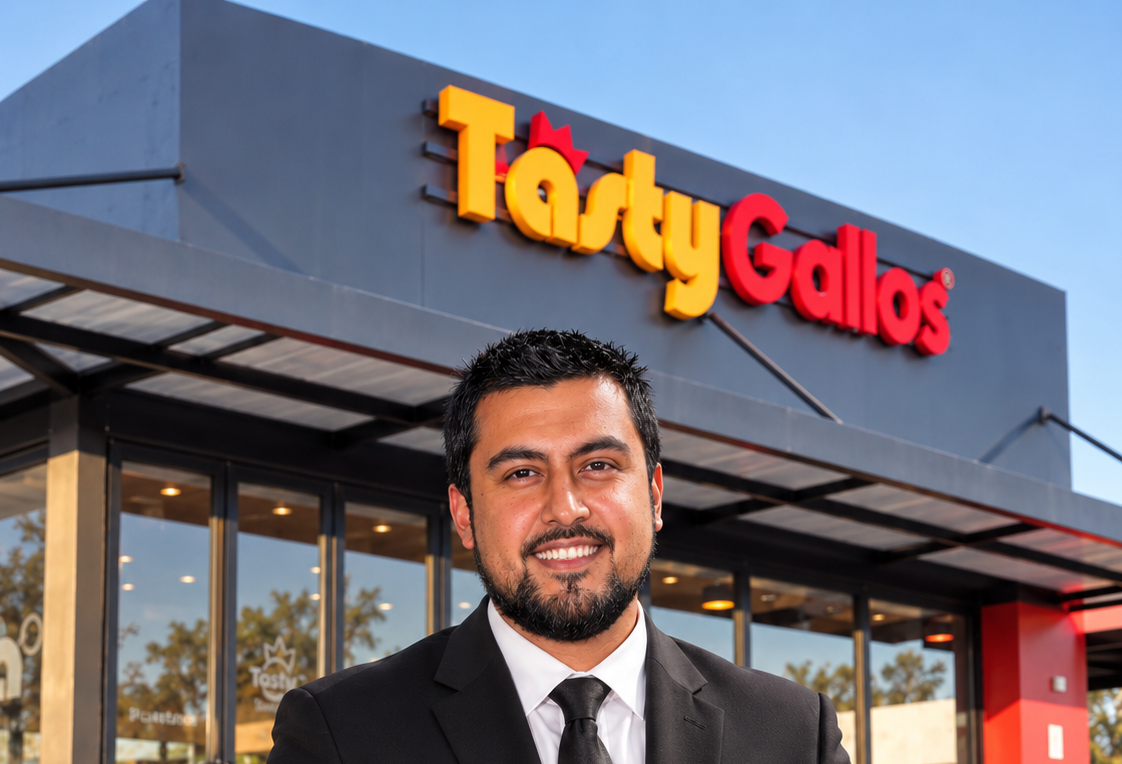
Having enough money to buy a Tasty Gallos restaurant does not mean founder and CEO Muhammed Gutta will simply sell you one.
Instead, before a single rand changes hands, every applicant must sit down for an interview to prove they have the business mettle and mindset needed to still be running their restaurant five years later, and applicants with the full R1.35 million required could still be turned away.
Gutta, who founded the chicken franchise in 2020, says the approach is guided by the principle that the ability to buy a restaurant is not the same as the ability to sustain one. To help franchisees succeed, he examines factors such as general business experience, income streams outside the proposed restaurant, and whether the applicant intends to take an active role in running it. An applicant can therefore meet the brand’s financial requirement of R1.35 million in unencumbered cash and still fail to secure approval.
“Anyone can sell you a restaurant, especially an established franchised business. I want to know whether you’ll still be running it in five years, because that’s what makes the franchise sustainable, and that’s the only version of this model that will work for both of us,” he says.
Gutta’s five-year test comes as South Africa is producing more new entrepreneurs, but proportionately fewer established business owners. The Global Entrepreneurship Monitor (GEM) puts early-stage entrepreneurial activity in South Africa at 15% of adults in 2025, up from 11% in 2023, while established business ownership fell from 6% to 4% over the same period.
For franchisors, that disconnect carries a direct commercial risk. Every failed outlet weakens the network, absorbs management attention, damages confidence in the brand, and can make future expansion harder. With Tasty Gallos restaurants operating across multiple locations and further expansion underway, Gutta notes the emphasis is on the durability of the network rather than store openings alone.
“Selling another restaurant may grow the network on paper but placing it with the wrong operator can create problems for years. That puts more responsibility on us to make the right call at the beginning. We learnt that the hard way.”
He explains the policy has evolved through experience. Tasty Gallos initially placed greater weight on whether prospective franchisees could afford the investment but found that capital alone was a poor predictor of long-term performance. Some drew too much income from the business too early or entered with unrealistic expectations around the timing of returns on their investment, while others were too removed from the daily running of the restaurant to address operational problems timeously.
“That changed the way we looked at franchise applications. Having the money tells me you can open the restaurant. But what matters is whether you can make the most of the opportunity once the doors are open.”
One of his biggest considerations is whether the prospective franchisee needs the restaurant to start paying them an income immediately. If so, the pressure to withdraw money before the business has established itself can quickly strain working capital and compromise an otherwise viable operation.
Meanwhile, for selected applicants who want to own a restaurant without running it day to day, Tasty Gallos may, at its discretion, offer a separate management arrangement. Under this arrangement, Head Office takes on the management of the restaurant for a fixed monthly fee, while the franchisee retains ownership of the business. The model allows for passive ownership in selected cases, while ensuring close oversight of the restaurant remains in place.
For Gutta, the commercial logic is simple. Selling a franchise generates an upfront return, but a failed restaurant can cost the wider network far more over time.
“Our business interests have to be aligned. I don’t want someone to open a Tasty Gallos for six months or a year. I want them to build a business that is still successful years from now, because if they succeed, we succeed.”