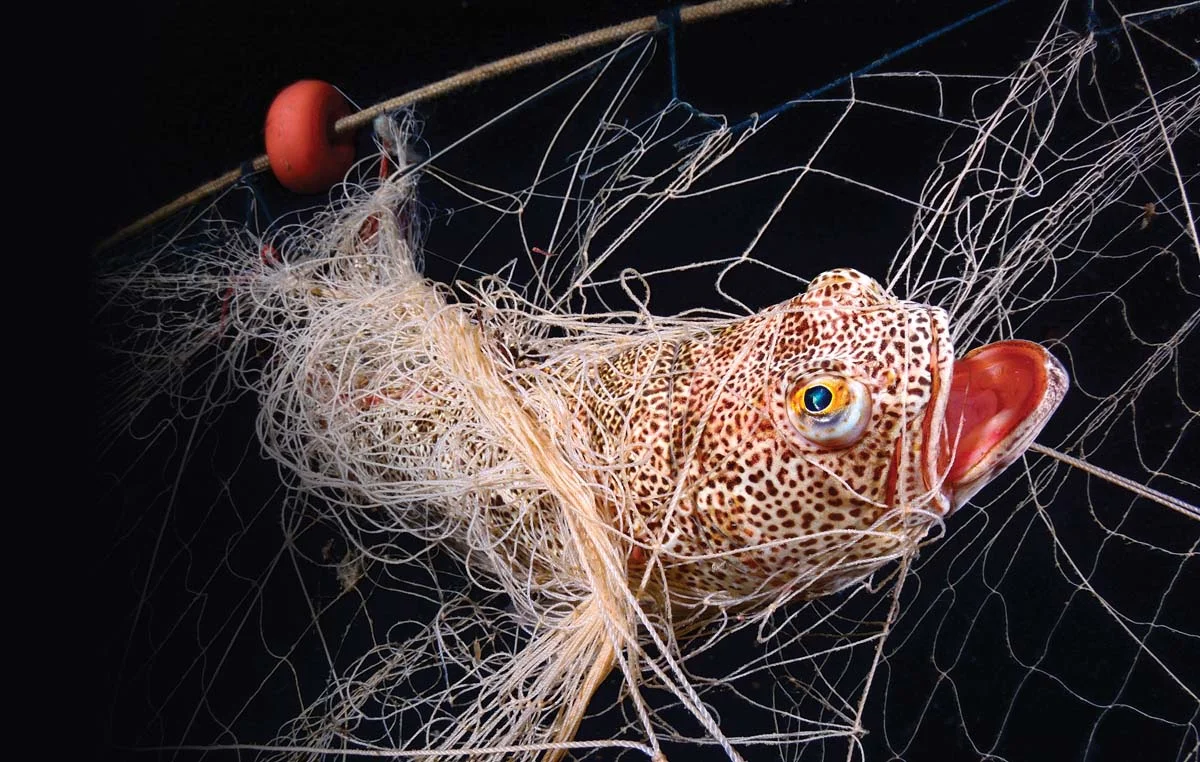
Illegal gillnetting activities are on a steep rise in South Africa, with the reported number of incidents being estimated at more than eight times higher than it was ten years ago. In many cases, gillnetters are not working in isolation. Evidence suggests that these nets are being marketed as crop covers, soccer nets, and fruit and vegetable bags to side-step the law. They are cheap, readily available and easily accessible. Evidence of gillnetting being linked to organised crime has sparked the development of the “Gillnet Reporting App” to assist with the eradication of this destructive fishing method.
WHAT ARE GILLNETS?
Gillnets are set in the water vertically, weighted down at the bottom and held up at the top by floats. They often span the entire depth of water and are used to entangle any fish or animal that may encounter them. Gillnets indiscriminately catch species in and on the water, including endangered species and animals they catch unintentionally. Gillnets trap fish of all sizes, including juveniles, disrupting the reproductive cycle and reducing the population by preventing new fish from reaching adulthood and reproducing. Without this reproductive cycle, no new fish are entering the water, and this affects the amount of fish available to catch in both freshwater and the sea. Sharks, rays and many fish use estuaries as nurseries for their young, making them vulnerable to getting caught and killed in these illegal gillnets. This is problematic considering some sharks and rays are more endangered than rhinos.
Their fine mesh and passive design make gillnets highly unselective, contributing to overfishing, habitat disruption, and biodiversity loss. This illegal method undermines ethical, responsible, and sustainable fishing practices. Gillnets are also a danger to public safety. Apart from gillnetting being an illegal fishing practice*, they endanger the lives of water users such as paddlers and swimmers.
Gillnets also contribute to the problem of pollution and are often swept away, lost or discarded in our oceans and waterways. Here, they act as ‘ghost nets’ that continue to entrap and kill other animals like water monitors, birds, turtles and dolphins. These nets can drift or get stuck for years, silently trapping various animals or getting snagged in critical habitats like coral reefs, posing hazards to animals, ecosystems and people.
“There is a general misperception that gillnetting is only for ‘hand-to-mouth’ fishing for food, when it is in fact also organised crime,” says Lieutenant Colonel Dean Nieuwoudt of the eThekwini Metropolitan Police Coastal Policing Unit. “The information that we receive on the gillnetting app is extremely important to law enforcement as it allows us to use ‘smart policing’ techniques.”
“GILLNET REPORTING APP” ENTERS THE ROOM…
“The gillnet reporting app has empowered citizens, law enforcement and conservationists to collaborate, share intelligence and implement targeted enforcement – when and where it matters most,” says Dr Jennifer Olbers, Senior Scientist at WILDTRUST.
The Gillnet Reporting App was recently developed by the National Department of Forestry, Fisheries and the Environment (DFFE), in collaboration with non-profit organisation, WILDTRUST; eThekwini Metropolitan Police; KZN Department of Economic Development, Tourism and Environmental Affairs (EDTEA); South African Police Services (SAPS); Ezemvelo KZN Wildlife; Council for Scientific and Industrial Research (CSIR) and various KZN civilian anti-poaching groups.
“This app gives all water users the ability to contribute to law enforcement activities by logging any gillnetting activity in our waterways onto the platform. Although immediate action cannot be expected, information provided by members of the public will be used by authorities to plan their interventions accordingly,” says Anthony Malgora, Acting Manager Amenities Coastal for Aquatic Safety & Law Enforcement, at eThekwini Aquatic Safety.
“The information and data logged onto the app enables enforcement to plan operations, make arrests and be more effective,” says Colonel George Morey, who recently retired from the South African Police Services (SAPS).
HOW CAN YOU HELP?
Download the app and join us in protecting our waters, our aquatic animals, and our water users.
Step 1: Download (free) Survey123 from your relevant App Store.
Step 2: Open Survey123 App on your device, click on ‘continue without signing in’; click on the QR code symbol on the upper right-hand side and scan the QR Code to install the Gillnet Reporting App.
If you suspect that you have come across illegal gillnetting activities, we encourage you to report it on the “Gillnet Reporting App”, to your local conservation agency, or to the Department of Forestry, Fisheries and the Environment via email – fisheries.compliance@dffe.gov.za or call 0800 205 005.