
South Africa’s economic future will not be built by large corporations alone. It will be shaped by entrepreneurs who create opportunities where they live, invest in the communities they serve, and build businesses designed to endure beyond a single generation.
Family-owned businesses remain one of the country’s most important economic assets. They create jobs, stimulate local economies, develop future business leaders, and provide stability during periods of economic uncertainty.
This contribution is particularly significant in South Africa, where small and medium-sized enterprises (SMEs) account for most businesses, contribute between 30% and 40% of Gross Domestic Product (GDP), and support approximately 60% of private-sector employment. Yet despite their importance, our country continues to face challenges in growing entrepreneurial activity, with business creation rates remaining below global averages.
Entrepreneurship that creates lasting impact
One of the greatest misconceptions about entrepreneurship is that success is measured solely by business growth. In reality, successful entrepreneurship creates a multiplier effect. It generates employment, supports suppliers, develops skills, and creates opportunities that extend far beyond the business owner.
This is evident within the SPAR retailer network where retailers are entrepreneurs who live in the communities they serve, and who own and operate their businesses while benefiting from the scale, support, expertise, and buying power of a nationally recognised brand.
This model enables retailers to remain deeply connected to the needs of their local communities while operating competitive, sustainable businesses. Across the country, several multi-generational SPAR retailer families demonstrate how this entrepreneurial model continues to create long-term value.
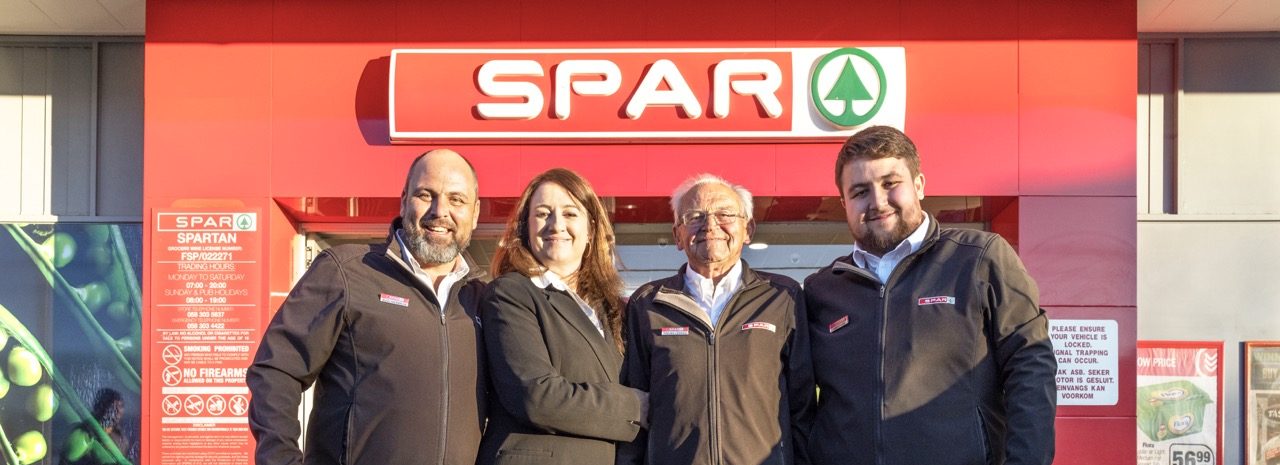
The Harbron family, owners of SPAR Spartan in Welkom and KWIKSPAR Dericks in Virginia, have spent decades building a business that now spans three generations. What began with a single store has evolved into a growing family enterprise that combines experience with fresh leadership.
The Orros family has similarly demonstrated how entrepreneurial businesses can evolve over time. Since acquiring SPAR Bloemhof in 2009, they have expanded their footprint by acquiring SPAR Goldfields, a second store approximately 200 km away, while actively developing the next generation of leadership within the business.
These are not simply succession stories. They are examples of entrepreneurial continuity where knowledge, relationships, and business acumen are intentionally transferred to ensure long-term sustainability.
The importance of community-based business ownership
Unlike large retail chains, where decision-making occurs far from the communities in which the stores operate, independent SPAR retailers are embedded within their communities. They live there. Their children go to school there. Their customers are often their neighbours – and their employees know them by name. Their success is intrinsically linked to the success of the towns and cities in which they operate.
Research shows that SMEs play a critical role in community development, employment creation, and economic participation across South Africa. The Department of Small Business Development estimates there are now more than 2.6 million SMMEs operating in the country, highlighting the scale of entrepreneurial contribution to the national economy.
For many communities, family-owned retailers are far more than places to shop. As some of the most visible and trusted local businesses, they plan an integral role in community life by supporting local schools, sports clubs, community organisations, charities, local suppliers. They also provide employment opportunities close to home and are among the first to respond when communities face challenges such as floods, fires and other crises. while creating employment opportunities close to home.
Resilience is built over generations
Perhaps the most remarkable characteristic of multi-generational businesses is resilience.
South African entrepreneurs operate in a challenging environment marked by economic pressure, infrastructure constraints, rising costs, and changing consumer expectations. Yet family-owned businesses continue to adapt and grow.
The Van Der Walt family’s journey illustrates this resilience. Following the passing of his father in 2020, Stefan Van Der Walt stepped into leadership alongside his mother, continuing the family legacy while expanding their retail footprint across the Free State. They own and operate SPAR Constantia, SPAR McLeans and SUPERSPAR Sylvania, all in various communities in Welkom.
Similarly, the story of Tertius and his children, Hannerie and Philip, demonstrates the determination required to overcome adversity. After enduring significant personal loss and a devastating store fire, the family rebuilt and expanded their business, creating opportunities for future generations across multiple stores, including SPAR Douglas in Northen Cape.
These stories remind us that resilience is not merely about surviving challenges. It is about continuing to persevere – to invest, grow, and create opportunities despite them.
Succession planning: An overlooked economic priority
Globally, only around 30% of family businesses successfully transition into the second generation, and even fewer survive into the third. Businesses that achieve multi-generational sustainability therefore represent a significant entrepreneurial achievement.
The next generation of business leaders must therefore be developed intentionally. Within many SPAR retailer businesses, succession begins long before leadership changes occur. Future leaders often gain practical experience from a young age, learning every aspect of the business before assuming greater responsibility.
The Viveros family exemplifies this approach. What began as a father-daughter partnership evolved into a multi-store operation, demonstrating how early involvement and mentorship can create a pathway for sustainable business growth. Their footprint now includes SUPERSPAR Aljo’s in Bloemfontein.
As South Africa seeks to stimulate entrepreneurship and job creation, greater attention must be given to building businesses that are not only successful today but sustainable for future generations.
Building a legacy economy
The conversation around economic growth often focuses on attracting new investment and creating new businesses. While both remain critically important, equal attention should be given to preserving and growing existing entrepreneurial success stories.
Businesses that successfully transition from one generation to the next represent a powerful form of economic resilience. They preserve jobs. They retain local knowledge. They strengthen communities. And they demonstrate that entrepreneurship can be a long-term legacy rather than a short-term venture.
At SPAR, we are proud to partner with independent retailers who embody these values every day. As South Africa looks for solutions to drive inclusive growth, create employment, and strengthen local economies, multi-generational family businesses offer an important reminder that sustainable economic impact is often created not over years, but over generations.
Because when entrepreneurship is rooted in community, guided by strong values, and passed from one generation to the next, its impact extends far beyond the balance sheet.