South Africa was home to 48,200 resident dollar millionaires as at June 2026, alongside 131 centi-millionaires and 10 billionaires, according to the 2026 Africa Wealth Report compiled by New World Wealth and published with Henley & Partners. The country accounts for 38% of Africa’s millionaires and 36% of its billionaires, and ranks 34th globally by millionaire residents, behind Poland and ahead of Turkey and Thailand.
The thresholds matter to how the figures read. A high-net-worth individual is defined as holding $1m or more in investable assets, roughly R16.2m at current exchange rates, excluding a primary residence. A centi-millionaire holds $100m, about R1.6bn, and a billionaire $1bn, approximately R16.2bn.
The annual increase is steep. The 2025 edition of the same report put South Africa at 41,100 millionaires and 34% of the continental total, so the resident count has risen roughly 17% in twelve months while South Africa’s share of Africa’s wealthy has climbed four percentage points.
Two qualifications sit behind that trajectory. The first is historical. The 2025 edition of the report recorded a 6% decline in South Africa’s millionaire population between 2015 and 2025, a decade in which Nigeria’s high-net-worth population fell 47%. The current figure therefore represents a recovery from prolonged attrition rather than uninterrupted accumulation.
The second is methodological. The report measures wealth in dollars. A stronger rand mechanically lifts the dollar value of rand-denominated assets and moves individuals across the $1m threshold without any change in what they actually own. New World Wealth has acknowledged the reverse effect elsewhere, noting that currencies in Nigeria, Egypt, Angola and Zambia fell more than 75% over the past decade, pushing thousands of people out of the millionaire count irrespective of underlying asset quality. The same arithmetic works in South Africa’s favour when the currency appreciates.
The report attributes the country’s standing to its diversified economy, established financial sector, private healthcare system and educational institutions, alongside lifestyle factors including climate, coastline and luxury residential estates. It describes the Johannesburg Stock Exchange as the 17th-largest exchange in the world by market capitalisation and points to a well-developed fund management industry.
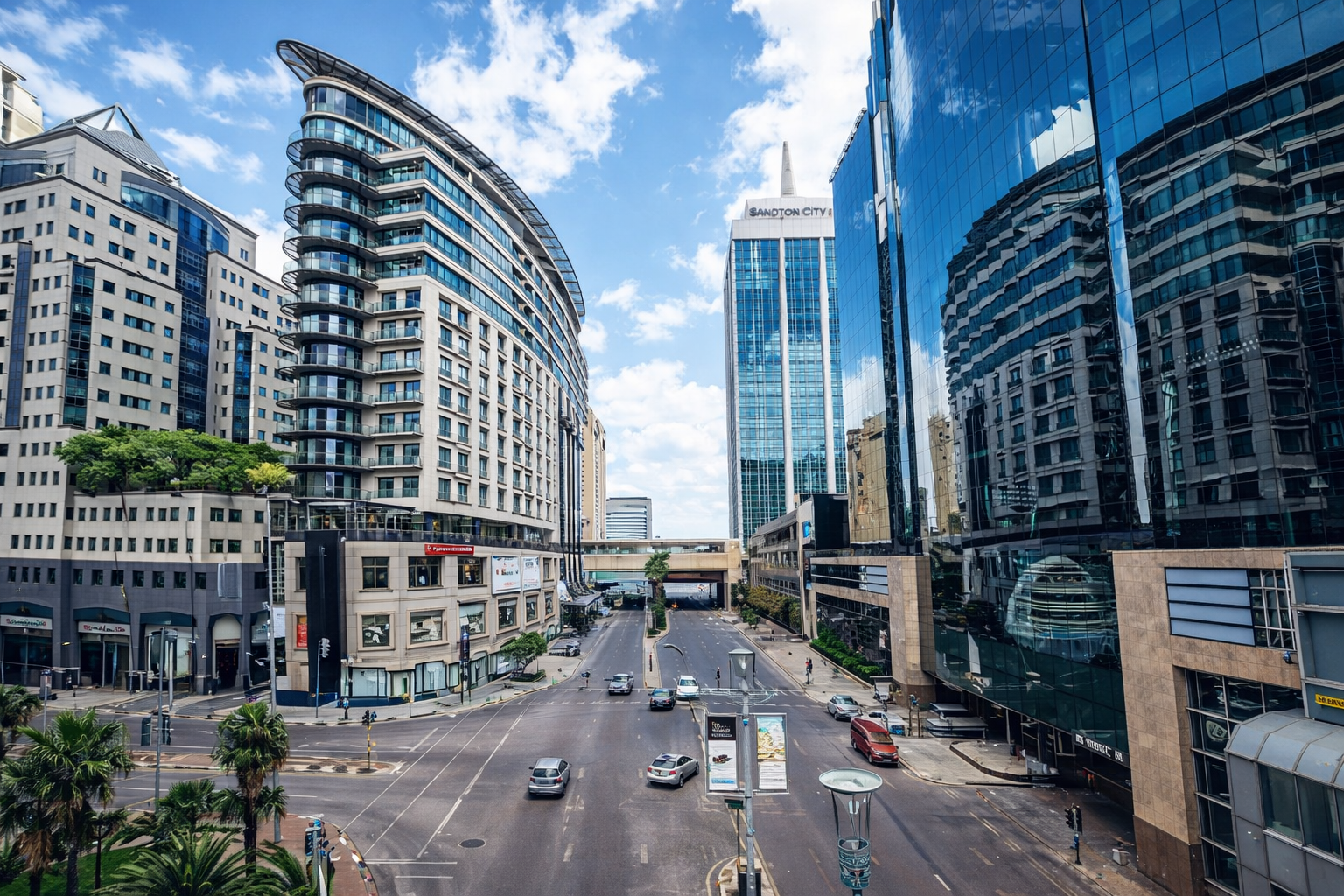
Johannesburg remains Africa’s wealthiest city, with much of that wealth concentrated in Sandton, home to a substantial share of JSE Top 40 companies, and with Waterfall-Midrand identified as an emerging hub built around lifestyle estates. Cape Town ranks second, its wealth having grown 35% over the past decade, and Henley has previously projected that it could overtake Johannesburg on total wealth by 2030.
The sharpest growth has occurred outside both metros. The Whale Coast, taking in Hermanus, Rooi Els and Betty’s Bay, recorded 63% wealth growth over the decade, the Cape Winelands of Stellenbosch, Paarl and Franschhoek 55%, and the Garden Route, which includes Plettenberg Bay, George, Knysna, Wilderness and Mossel Bay, 43%. Each outpaced the major cities, consistent with the movement of affluent households towards coastal and lifestyle towns.
The report’s publisher holds a commercial position in the subject. Henley & Partners sells residence and citizenship by investment, and has previously reported a 50% surge in enquiries during 2024, with South Africa among the world’s top ten source markets. Wealth counted as resident is not necessarily immobile.
The figures also sit against a weaker national picture. South Africa’s economy contracted 0.2% in the second quarter of 2026, while unemployment continued to rise.