
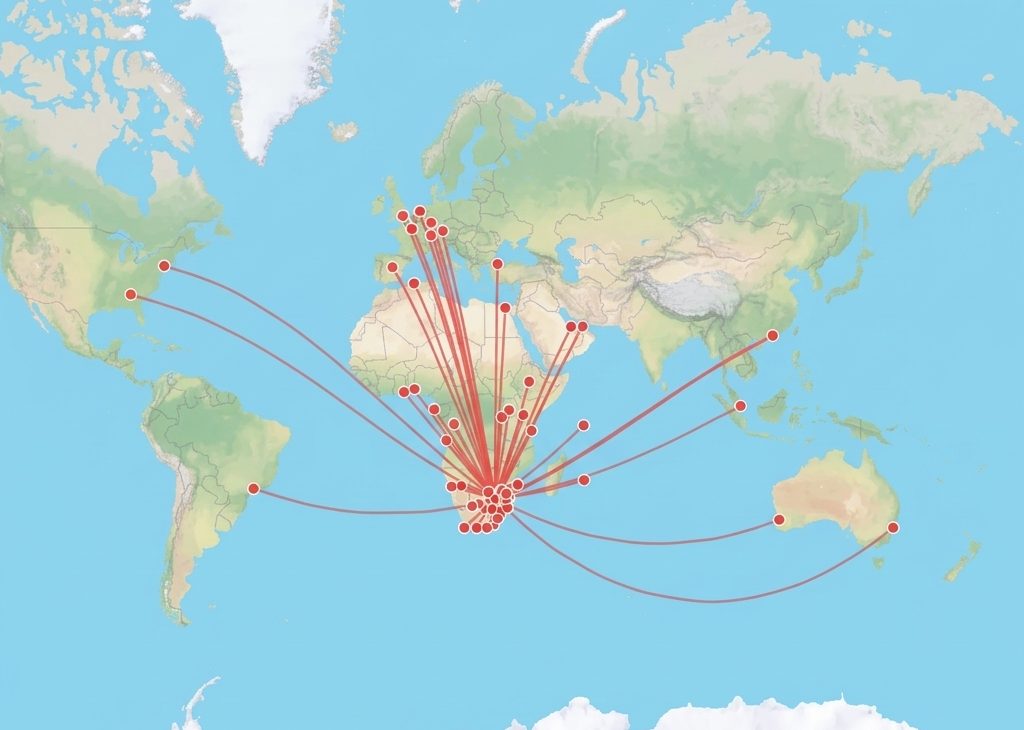
Just under a million international tourists arrived in South Africa in July. The precise figure, 991 696, sits 12% above the same month last year and lifts the 2026 running total to 6 576 169, growth of 12.4%.
Then look at the passports. Arrivals from elsewhere on the continent are up 14.3% so far this year. Overseas arrivals are up 5.7%. Africa is growing at roughly two and a half times the pace of the long-haul markets, and Tourism Minister Patricia de Lille has framed that shift as strategy rather than serendipity.
For a sector that has spent much of the year fielding questions about whether public sentiment around immigration might deter visitors, the numbers paint a different story, and they point clearly to where the answer is coming from.
National arrivals statistics tell us who crossed the border. Booking data tells us who is filling the rooms, and at The Capital Hotels, Apartments and Resorts the two are telling the same story. Zambia recorded growth at eight of the eleven properties where it registers as a source market. Kenya grew at six of ten. Botswana and Eswatini are both trending upward across the portfolio.
“Regional business travel is expanding, and travellers from across the continent have become a genuinely important market for South African hospitality,” says Garnet Basson, COO of The Capital Hotels, Apartments and Resorts. “Zambia and Kenya are the clearest examples in our own numbers, and they reflect stronger commercial and cultural ties between South Africa and the rest of the continent.”
The regional picture rests on a stable domestic base. South Africans now account for more than 60% of Booking.com demand across The Capital’s twelve properties. Overseas markets remain meaningful too: the United States was South Africa’s leading overseas source market for a second consecutive month in June.
The continental guest stays longer
Average length of stay across The Capital’s portfolio held steady year-on-year at 2.43 nights, though the monthly pattern is where the useful detail sits. January and February saw shorter stays than in 2025. From April the trend reversed and, May stands out: average stays lengthened from 2.32 to 2.57 nights, a 10.8% increase.
The distinction matters because room-night growth outpaced booking growth in several months. The additional demand came from travellers who were already coming and who chose to stay longer once they arrived.
Basson attributes this to a familiar cluster of behaviours, several of them characteristic of regional travel: extended business trips, leisure days added onto work travel, domestic breaks taken closer to home, and the steady normalisation of bleisure travel, where a single trip does double duty.
“A guest who adds two nights to a work trip is worth considerably more to the local economy than the room rate suggests,” he says. “They eat out, they book a tour, they spend a Saturday somewhere they would otherwise have flown over. That is what regional travel gives us: guests who are close enough to return often, and comfortable enough to stay a little longer each time.”
One portfolio, several different markets
The booking window data is a useful corrective to any assumption that hotel demand behaves uniformly. Zimbali carries an average booking window of more than 32 nights, while some of the more business-oriented properties sit at around five to seven. Leisure guests are planning a month ahead. Business guests are booking within the week.
For operators, that argues against a single national playbook. Regional demand rewards a different kind of planning, from route and airline partnerships through to how quickly a property can absorb a booking made four days out.
The stakes are worth stating plainly. Tourism sustained 954 000 direct jobs in 2024 and contributed 4.9% of GDP. Tourism Month tends to be measured in headline arrivals figures, and every one of those numbers is a person who chose to spend a night somewhere in South Africa. A growing share of them arrived from somewhere else on the continent. That is worth building for.