

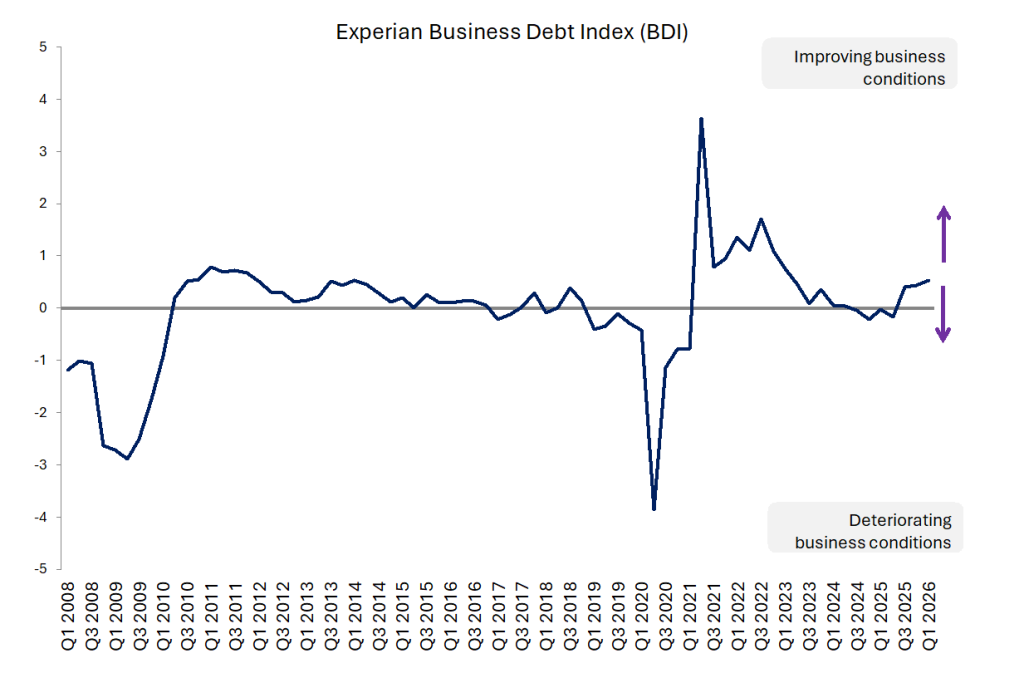
South African business debt conditions continued to improve in the first quarter of 2026, with the Experian Business Debt Index (BDI) rising to 0.53 from a downwardly revised 0.44 in Q4 2025. The latest reading keeps the index in positive territory for a fourth consecutive quarter, signalling that businesses are, overall, showing a stronger ability to settle outstanding debt obligations.
The improvement comes against a mixed economic backdrop. More favourable perceptions of South Africa’s policy environment, easing inflationary pressures and a cumulative 1.5% reduction in key interest rates supported consumer activity and business confidence. However, the economy continues to be held back by subdued gross fixed capital formation, ongoing pressures of deindustrialisation, and a growth trajectory that remains too modest to materially shift employment outcomes.
Business debt metrics show improving repayment behaviour
Experian data points to a constructive shift in repayment behaviour. While average outstanding debtors’ days rose to 50.9 in Q1 from 48.4 in Q4 2025, the underlying debt stress ratios improved. The 30- to 60-day debt stress ratio declined from 13.2% to 12.1%, while the 60- to 90-day ratio eased from 5.7% to 5.1%. These movements suggest that, despite longer average settlement periods, fewer businesses are moving into more advanced stages of debt stress.
Sector picture remains uneven as investment remains subdued
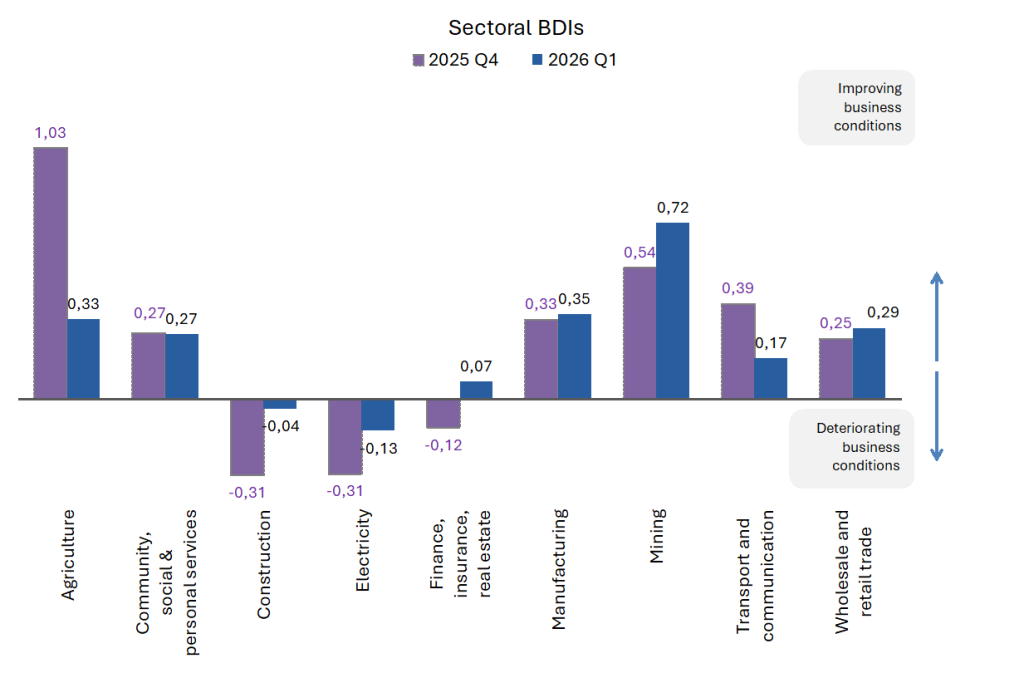
The sectoral picture was mixed. Mining recorded the strongest improvement, supported by higher mineral prices and increased activity, while agriculture declined sharply, largely due to statistical base effects. Construction and electricity remained in negative territory, indicating continued pressure in sectors closely linked to infrastructure development. The transport and communication sector also eased, reflecting ongoing logistics and structural reform challenges.
“The latest Experian BDI reading is an encouraging signal for South Africa’s business environment. A fourth consecutive positive quarter suggests that debt conditions are steadily normalising, supported by lower interest rates and better corporate repayment behaviour. However, the improvement remains gradual and uneven across sectors,” says Matiisetso Madito, Chief of Credit Bureau Services at Experian South Africa.
Measured outlook as businesses navigate an uncertain environment
Looking ahead, Experian forecasts the BDI to remain positive in Q2 2026 at 0.50, only marginally lower than the Q1 reading. However, the outlook is more finely balanced. Oil price movements, lingering inflationary pressures, uncertainty over the direction of interest rates and elevated public debt levels may influence business conditions over the coming quarters.
“The improvement in business debt conditions gives companies some breathing room, but it is not yet a signal that the economy has shifted onto a stronger growth path. Businesses should continue to manage cash flow, credit risk and supplier relationships carefully, while remaining alert to changes in input costs, margins and payment cycles,” says Madito.