


Is AI replacing workers at scale? The market, the Federal Reserve and commentators far and wide appear to believe that AI is already displacing jobs, setting the scene for further disinflation and rate cuts. Incoming evidence suggests this could be a false narrative. AI may well create slack in the future, but cutting rates now on the hopes of new technology – and especially in the light of events in Iran and the Middle East – would seem more like wishful thinking than prudent policymaking.
In the period since ChatGPT’s launch the share of job advertisements mentioning AI related skills has climbed steadily, according to recruitment site Indeed.com. But correlation alone does not tell us whether AI is truly weighing on job creation. There are other significant factors at play. To start with…
Labour conditions have softened globally since late 2022
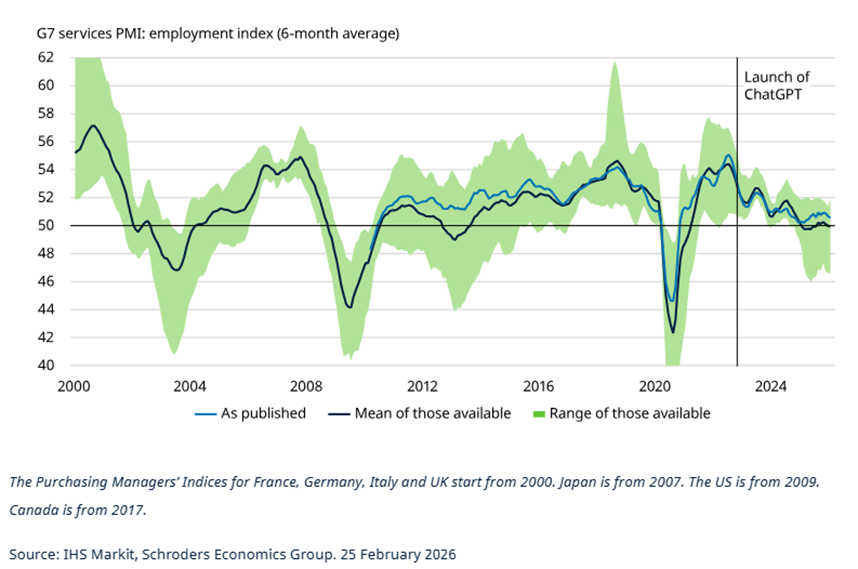
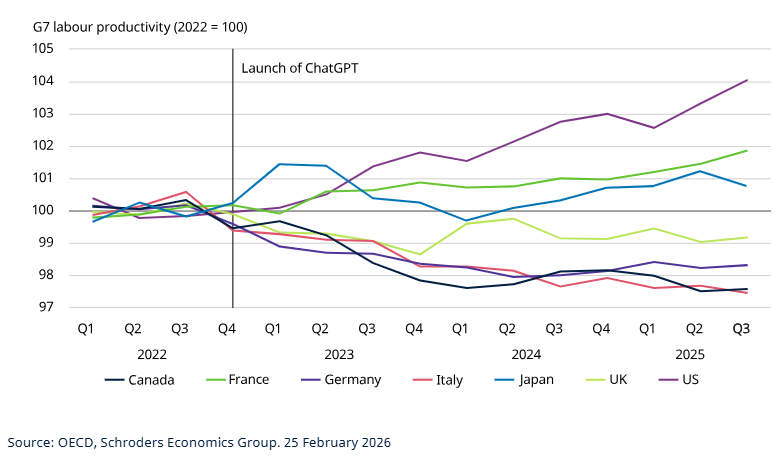
If AI were displacing workers meaningfully, there ought to be a clear improvement in labour productivity. Yet outside the US, there has been no discernible acceleration, suggesting that AI’s impact on G6 job markets has been limited so far.
However, we can’t rule this out for the US economy, given its productivity performance (see top line in the chart below).
G6 productivity is inconsistent with AI displacement
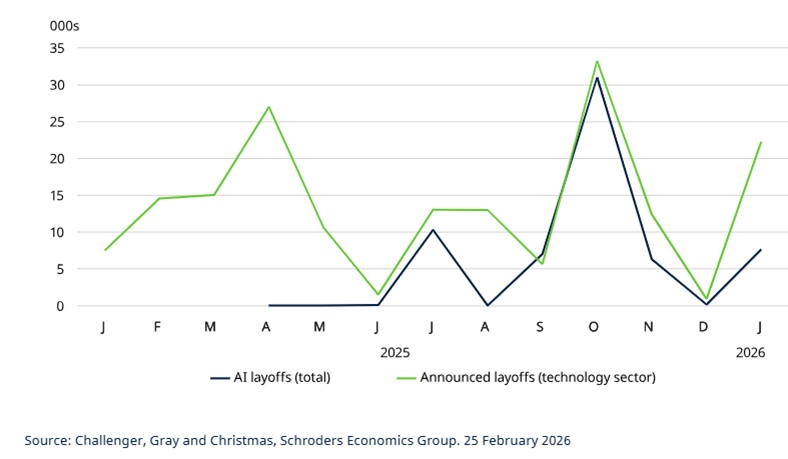
AI is increasingly being cited in US layoff announcements, with nearly 5% mentioning it in 2025. But these appear to be concentrated in the technology sector, which intuitively makes sense given the capex ramp-up in recent years.
As a share of real GDP, hardware and software investment has climbed by 1.7% points over the past 5 years.
Explicitly attributed AI layoffs are concentrated in the technology sector
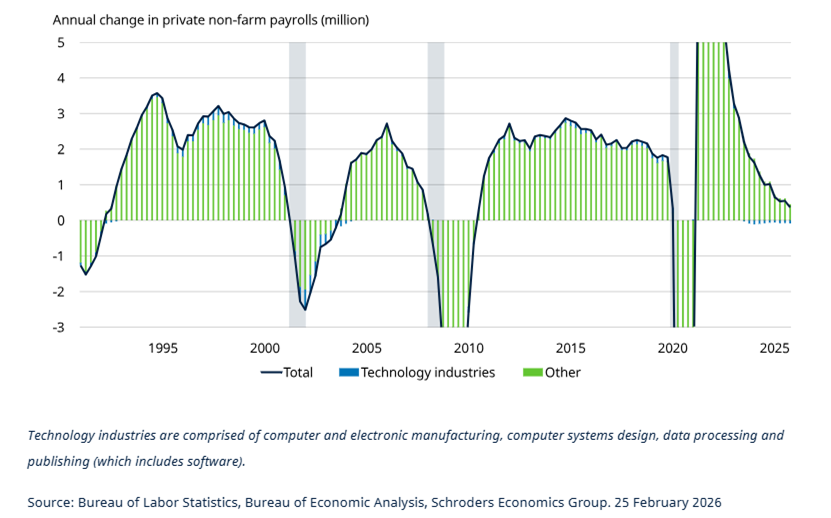
It is also notable that payroll employment for the sector peaked just after ChatGPT was launched. But factors unrelated to AI are also likely to have played a part. Over-hiring during the pandemic may be partially to blame, while the higher interest rate environment since the pandemic has been a significant headwind to the sector.
Shrinking tech payrolls has not held back the sector
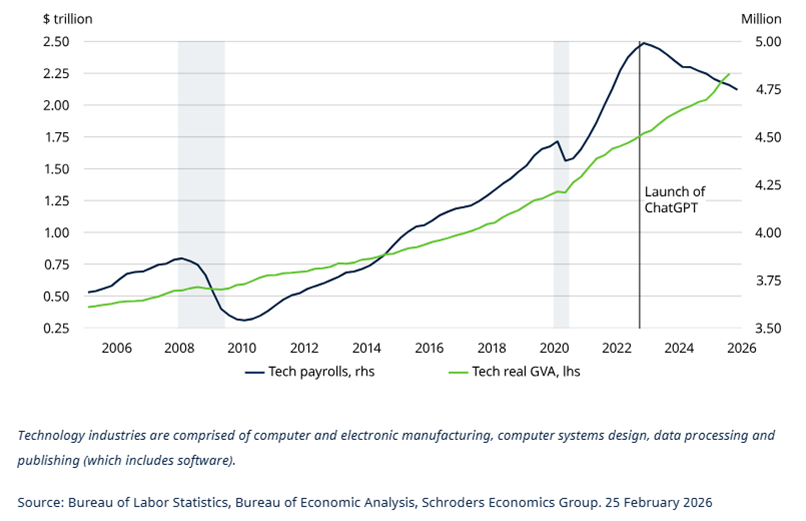
Whatever the reason, the 5% fall in technology employment from its peak accounts for only a fraction of the US jobs slowdown. Last year, the industry shed 75,000 jobs. Compare that to hiring in the rest of the economy, which was just 600,000 in 2025, or almost a tenth of the 5.5 million created in in 2022.
Tech layoffs account for a fraction of US jobs slowdown
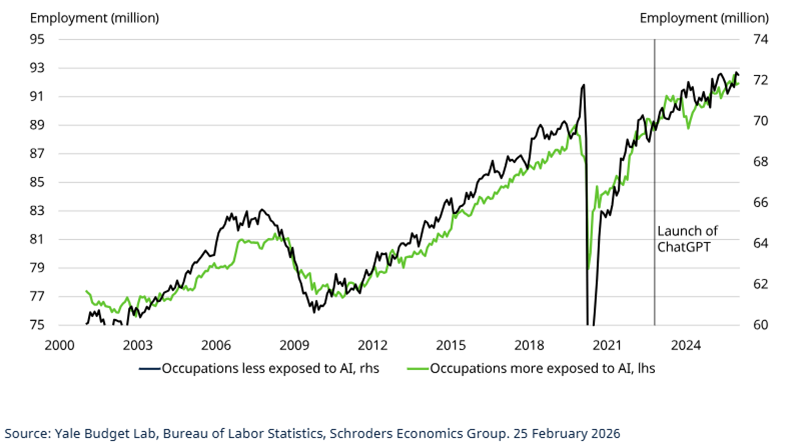
While we have established that AI has not led to a significant number of layoffs, it could still be weighing on job creation more broadly across the US economy. But a bottom-up analysis of occupational exposure to AI suggests there has been little difference between jobs more at risk of being automated than those less at risk since 2022.
Jobs vulnerable to AI appear largely unaffected
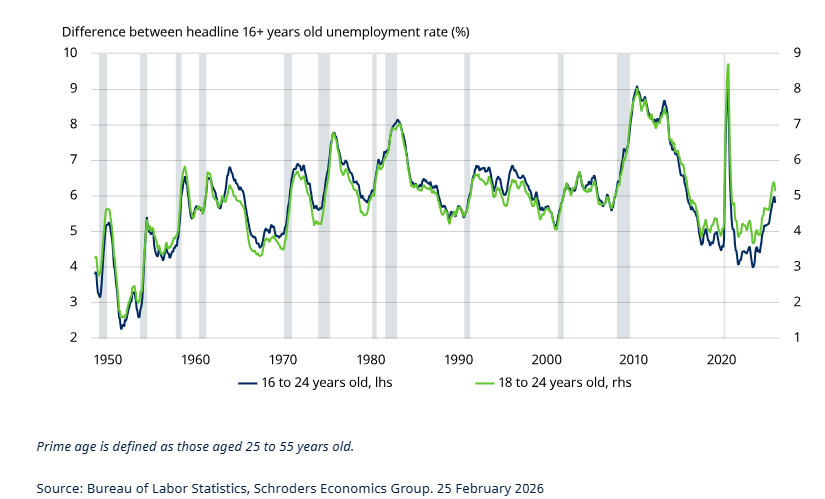
Another popular argument is that firms are no longer hiring entry-level roles because AI can perform many junior tasks. Yet measures of youth unemployment have not seen a structural departure from the prime age unemployment rate, suggesting that AI is not impacting labour demand at the margin.
AI doesn’t appear to be crowding out young workers
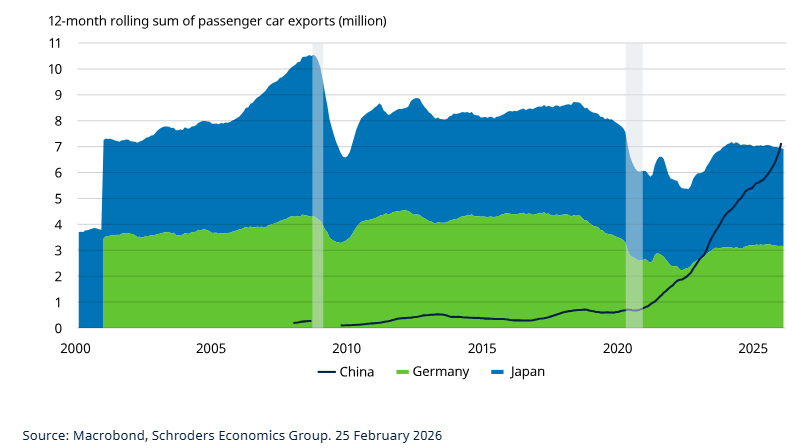
The slowdown in job creation globally can instead be more convincingly explained by a combination of non-AI factors. Tariff uncertainty is likely to have dampened labour demand across almost every economy. This is coupled with country‑specific headwinds, which could include increases in the minimum wage and employer National Insurance Contributions in the UK; and rising competitive pressures from China’s automotive industry for the likes of Germany.
Chinese car exports now exceed Germany’s and Japan’s combined
In the US, tighter immigration policies have also weighed on job creation. Research from the Federal Reserve (Fed) shows that the slowdown in employment gains since 2022 largely reflects lower labour supply rather than demand. Should hiring intentions pick-up whilst supply stays constrained, wage pressures could intensify as a result.
US jobs slowdown largely reflects lower labour supply
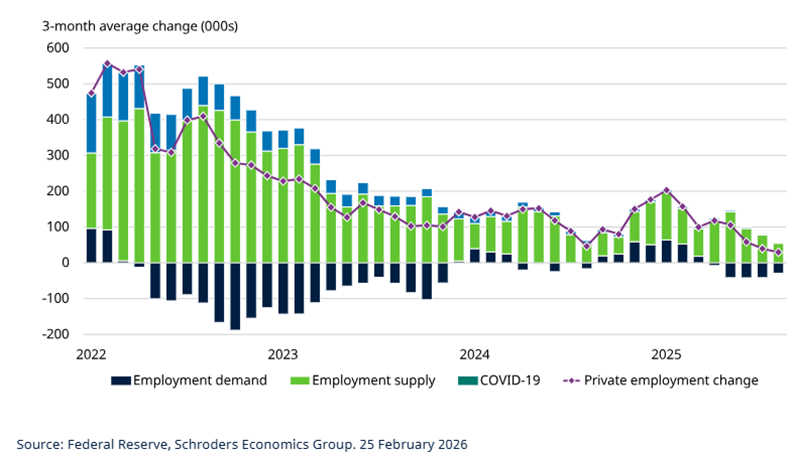
At face value, this implies inflation risks remain skewed to the upside. But the presumptive Fed Chair Kevin Warsh believes the US is in the midst of an AI productivity boom, implying scope for lower rates. Our dissection of labour trends since 2022 suggests that this boom has yet to arrive. Cutting rates now would therefore amount to a bet on an unproven technology, all whilst models imply policy is already accommodative.
Models imply fed funds rate is at or below neutral
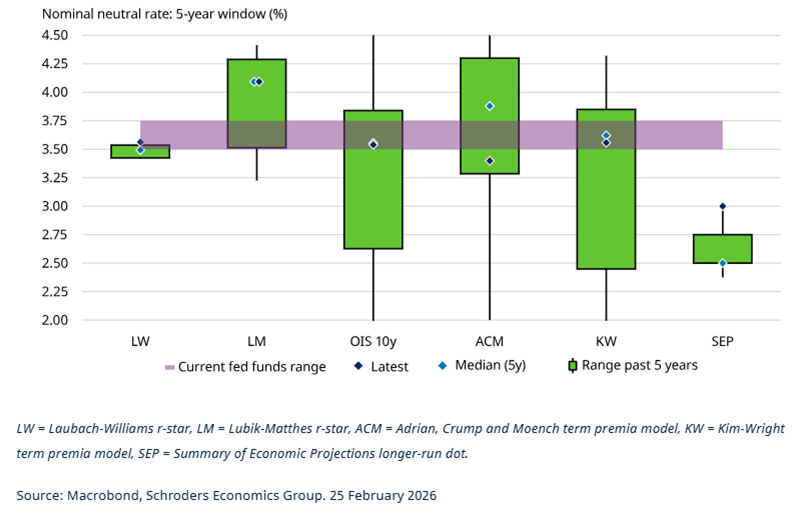
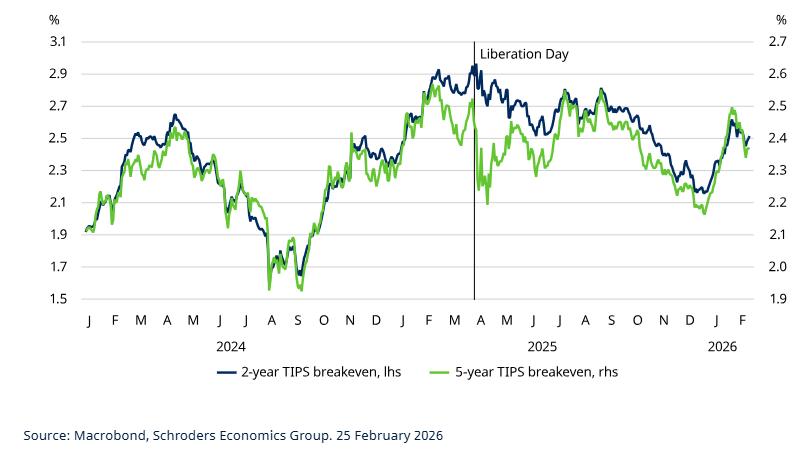
If US policymakers ease prematurely on the expectation of AI‑induced disinflation, they risk re‑igniting price pressures. The yield curve could steepen as a result as rally at the front end rubs up against a selloff in longer maturities, whilst breakevens also could climb higher as inflation becomes embedded.
Breakevens could climb higher if FOMC continues to cut
Written by George Brown, Senior US Economist at Schroders