

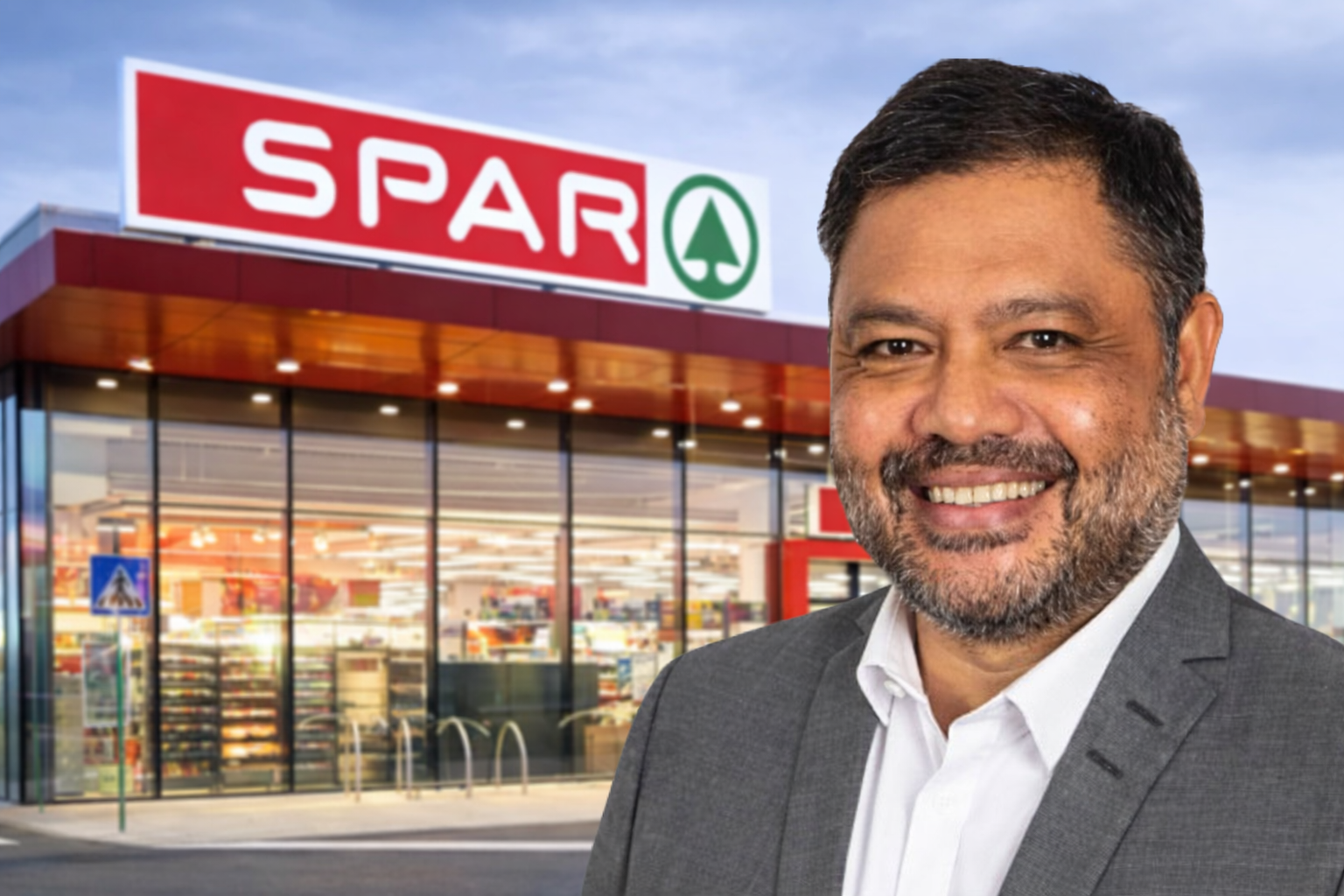
The SPAR Group today announced its interim results for the six months ended 27 March 2026, marking a decisive financial and operational reset for the organisation. Under the leadership of Group CEO Reeza Isaacs, who stepped into the role on 1 March, the Group has moved to confront historical execution gaps and refocus the business on its core engine: the independent retailer.
H1 FY2026 financial highlights:
- Group Turnover: R67.7bn (+2.1% vs H1 FY2025) below inflation, reflecting volume pressure.
- Group Gross Profit: Margin at 10.6%, broadly in line with the prior period (10.7%)
- Operating Profit: R730.7m (R882.0m before extraordinary items) – a margin of 1.1% (1.3% before extraordinary items), versus 2.1% in H1 FY2025.
- Headline Earnings Per Share (HEPS): 199.9cps (-55.5%).
- Net Debt: R7.3bn, up from R5.4bn at September 2025 on working-capital timing, and well below the R9.8bn peak in 2022.
- Retailer Loyalty: Stable at 78.5% on a 12-month rolling basis.
The results reflect a period of significant pressure, with operating profit affected by three main challenges: underperformance in KwaZulu-Natal (KZN), an ineffective Black Friday campaign that failed to deliver a return on investment, and residual balance sheet clean-ups. While the performance for the period demonstrates the scale of the challenge facing the Group, they also provide a clear baseline against which progress and recovery can be measured.
Isaacs provided a transparent assessment of the Group’s challenges: “These are not market problems; they are execution problems, and they are fixable. We allowed our cost base to outgrow revenue for too long. We also failed to treat retailer profitability as our primary metric. Confronting these issues openly is a necessary step in building credibility and ensuring that future performance is grounded in accountability and measurable execution.”
Under Isaacs, SPAR is shifting the focus from being a supplier to being a true partner to retailers, guided by the principle that “SPAR succeeds when our retailers succeed”. The Group’s recovery strategy is built around improving retailer outcomes first, based on the belief that stronger retailers create stronger volumes, stronger loyalty and ultimately a stronger SPAR system. In support of this, the Group has intensified engagement with independent retailers and the National Guild to ensure retailer concerns are heard and resolved more quickly, and is moving from ambition to action through five pillars of execution:
- Stronger Procurement, Better Pricing: Using Group scale to buy better, resolve wholesale price disparities and centrally manage the top 250 Key Value Items to protect retailer availability and competitiveness.
- Brand and Marketing Effectiveness: A full review of marketing spend is underway supported by a return-on-investment framework, to rebuild brand conviction around the community-focused independent retailer.
- Repositioning SPAR2U: Differentiating SPAR2U around a more personalised retail experience, supported by investment in a new platform and the continued growth of digital partnerships.
- Future-fit Retail Technology: Modernising retail systems and processes to give retailers real-time, store-level reporting and to remove manual processes while reducing operational complexity.
- Empowering retailers to improve profitability: Benchmarking, staff-scheduling tools, rental-negotiation support and cost-effective revamps to ease the squeeze on retailer profitability – now the Group’s primary operating metric.
Importantly, these initiatives are not future ambitions. Each programme has defined ownership, measurable milestones and clear operational targets. The Group intends to report transparently on progress against these interventions as they mature.
In KZN, a structured stabilisation programme has restored three consecutive months of operating profit to close the half, with out-of-stock rates materially improved and a new local perishables model supporting better availability and revenue growth. New leadership is in place across Merchandise, Finance and Retail Operations.
Outside of South Africa, the Group has reached the final milestone in its portfolio simplification with the exit from Southern England (AWG), following the disposal of Polish and Swiss assets in previous periods. This allows leadership to focus entirely on the core South African and Irish (BWG) markets. BWG Foods in Ireland delivered a solid performance with sales of €855.7m (+2.2%) and improved gross margins, demonstrating the resilience of the independent model. The business continues to provide a strong example of how independent retailers can outperform when supported by the right wholesale infrastructure, operating disciplines and customer proposition.
While the interim numbers are under pressure, SPAR’s leadership believes early indicators suggest that the corrective actions underway are beginning to gain traction. Gross-profit growth turned positive in February and March, KZN service levels have improved, SPAR Health grew 26% and retailer support initiatives provide initial evidence that the operational fundamentals are moving in the right direction.
SPAR Rewards’ sales grew 9.3% year-on-year with the SPAR Rewards programme now with 12.8 million registered cards, and members spending 74% more per basket than non-members. The programme continues to deliver valuable customer insights that support improved ranging, pricing and promotional decisions across the retail network.
“The path forward is about proof, not promises,” said Isaacs. “We are committed to rebuilding trust one store at a time by fixing the engine room that powers our retailers. Recovery will not be defined by a single reporting period. It will be defined by consistent operational improvement, stronger retailer outcomes and visible progress over time. We believe in the independent retail model because it offers local relevance that other retail chains cannot match. We are grounded, we are fixing the fundamentals, and we are invested in our retailers’ wins.”