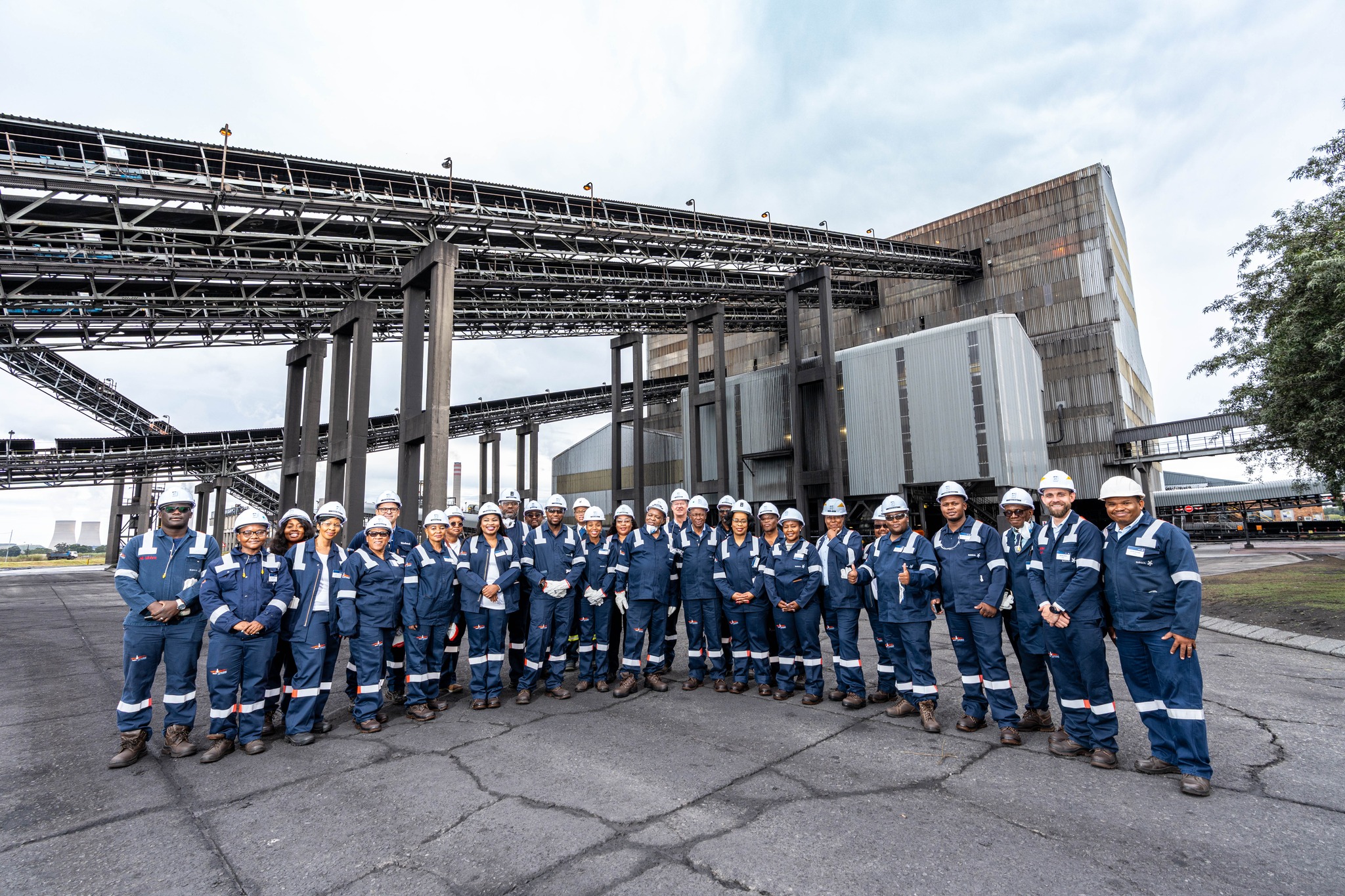
Sasol formally opened its new Destoning Plant in Mpumalanga on Friday, marking the completion of a project that has been central to the group’s strategy for recovering production at its Secunda Operations. The occasion drew Minister of Mineral and Petroleum Resources Gwede Mantashe, who framed the investment as evidence that South Africa’s mining sector remains capable of transformation and that coal, despite its detractors, continues to anchor the country’s industrial economy.
The facility was developed through the conversion of the Twistdraai Export Plant — a brownfield repurposing that cost less than R1 billion, compared to estimates of up to R6 billion for a greenfield alternative. The plant processes run-of-mine coal from the Thubelisha and Bosjesspruit mines, removing high-density stone before the material enters Sasol’s gasification process at Secunda. Since achieving beneficial operation in December 2025, the plant has reduced average sinks levels — the stone and impurity content of feedstock coal — for the first quarter of the 2026 financial year to below 14%, and Sasol is targeting a further reduction to below 12% as output ramps up. The facility has a processing capacity of 10 million tons per year.
The operational context behind the investment is significant. Secunda produced 6.7 million tons of liquid fuels and chemicals in the year to June 2025, falling short of a target range of 6.8 to 7 million tons. Stone content at some of Sasol’s mines had risen as high as 20%, reducing gasifier yield, accelerating mechanical wear, and forcing the group to purchase external coal to compensate for shortfalls. At its 2025 Capital Markets Day, as noted by Sasol’s press release, the group committed to the destoning project as a primary lever for lifting Secunda output back above 7.4 million tons per year — a level last achieved four years ago. CEO Simon Baloyi stated that the plant is already delivering measurable quality improvements, with sinks levels trending downwards since commissioning.
The strategic logic is straightforward. Sasol operates approximately 74 gasifiers at any one time, requiring at least 72 to be functional to stay within its target production range. High stone content has reduced the volume of syngas produced per gasifier and caused damage that reduces the number of operational units at any given time. By improving coal quality at source, the group expects both yield per gasifier and overall gasifier availability to increase, lifting Secunda’s output and reducing maintenance costs through its production chain of synthetic fuels and chemicals.
The plant also carries significance beyond Sasol’s balance sheet. Mantashe, addressing the opening ceremony, noted that coal has underpinned South Africa’s energy economy since the late 1860s, and remains the feedstock for Eskom’s coal-fired fleet, which still provides the bulk of the country’s electricity generation. South Africa ranks among the top ten coal-producing nations in the world and is the continent’s largest producer, and Mantashe pushed back on arguments that the country should accelerate its exit from the fuel, pointing instead to initiatives such as Carbon Capture, Utilisation and Storage as evidence that cleaner coal utilisation remains a viable path alongside renewable development. He also linked the investment to the broader imperative of mineral beneficiation — adding value to raw materials at source rather than exporting them for processing elsewhere, a pattern he described as having cost the country jobs and profits for decades.
The project also has immediate relevance for Sasol’s longer-term energy supply picture. The group’s gas imports from Mozambique — which supplement coal as a feedstock at Secunda — are set to taper for domestic industrial customers from 2028, a deadline that has come to be referred to internally as the “gas cliff.” By improving the efficiency and output of its coal-based gasification capacity now, Sasol is building a buffer ahead of that transition. The group has indicated it will target annual Secunda output of approximately 7 million tons through to 2030, with the destoning plant positioned as the primary mechanism for sustaining that level.