
If you’ve ever bought traditional stocks before, you’re familiar with the practical side of owning shares in a publicly listed company. Open a brokerage account, place an order during market hours, and shares sit in that account until it’s time to sell.
The system works well, but it can be rigid for some investors: the benefits of owning shares – dividends, voting rights, lending – stay within the brokerage environment, while trading is capped by market hours.
A new format is now emerging, one that takes the familiar idea of stock ownership onto the blockchain. Tokenized securities, which are now available on Binance as bStocks, allow investors to hold 1:1 price exposure to select listed companies in their own wallet, trade them 24/7, automatically reinvest dividends distributed in the form of a multiplier and use them across the wider world of on-chain applications.
What’s the Difference Between bStocks and Traditional Stocks?
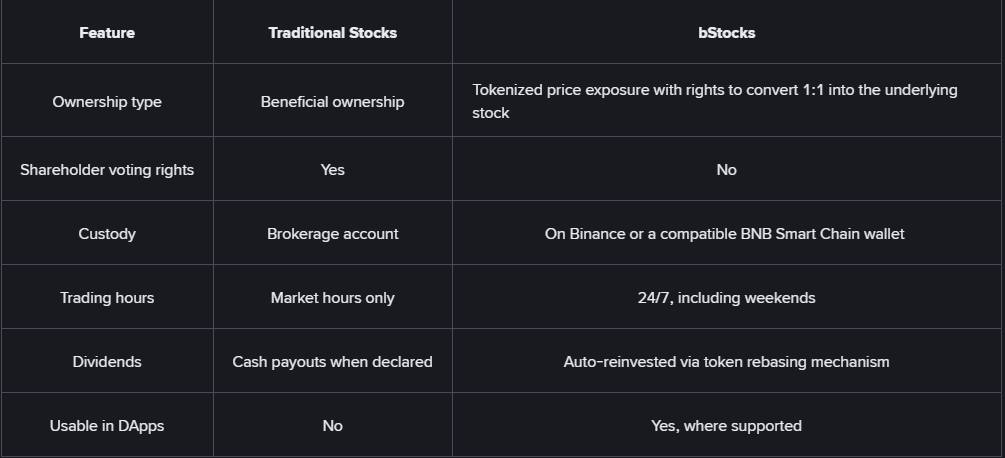
Traditional stocks give investors beneficial ownership in a company, including shareholder rights like voting. The tradeoff is that they only trade during market hours and must be held inside a brokerage account.
Tokenized securities like bStocks are designed to give investors 1:1 economic exposure to an underlying share held in a regulated custodian account. They can be withdrawn to a compatible BNB Smart Chain wallet, traded 24/7, and used with supported decentralized applications (DApps).
How do Traditional Stocks Work?
A stock represents a slice of ownership in a public company. When you hold a share, you’re entitled to a few things: you benefit if the company’s valuation rises, you may receive dividends when the company declares them, and depending on your share class, you might even get a vote on company decisions.
It’s a mature, highly liquid system that has been refined over generations. But as with all traditional systems, they come with their own limitations that may matter more to some investors:
- You’re tied to market hours. U.S. equities generally trade only during U.S. market hours. Some brokers offer extended 24-hour trading sessions, but you’re still limited to weekdays, with markets closed on holidays.
- Your shares live in a brokerage account. You own the shares, but they sit inside a brokerage’s custody system rather than a wallet you control directly.
- Limited utility. Brokerage-held shares are not blockchain-native, so they can’t interact with on-chain applications.
For most people, none of this is a dealbreaker. In fact, Binance offers a traditional stock experience too, with access to over 7,000 U.S.-listed stocks and ETFs in supported regions as well as 24/5 trading hours. But for users who’ve spent considerable time in crypto, many prefer the flexibility of holding assets on chain.
How Do bStocks Work?
bStocks are tokenized securities issued as BEP-20 tokens on BNB Smart Chain. Each bStock represents 1:1 price exposure to real shares of a U.S.-listed equity. Price exposure means your token gains or loses value based on the stock’s price, while the underlying share is held in a regulated custodian account. If the share price goes up, your bStock goes up; if it falls, your bStock goes down.
With bStocks, you can:
- Withdraw tokens to a compatible wallet for self-custody.
- Trade 24/7 via Binance Spot, including weekends.
- Use them with compatible on-chain applications, where supported.
- Swap them back to the underlying share with zero fees on Binance.
- Continue to enjoy dividends that are automatically reinvested in the form of a multiplier.
Note that going on chain doesn’t recreate every aspect of traditional stocks. Shareholder rights like voting aren’t supported currently, while dividends are automatically reinvested into bStock holdings instead of a direct cash payout.
As of writing, Binance offers bStocks for a curated list of names, with more to follow: MUB (Micron); SNDKB (Sandisk); CRCLB (Circle); NVDAB (NVIDIA); TSLAB (Tesla); SPCXB (SpaceX); AMDB (Advanced Micro Devices); INTCB (Intel); MSTRB (Strategy); EWYB (iShares MSCI South Korea ETF).
Trading pairs are available in USDT, where allowed.
Traditional Stocks vs. bStocks: Side-by-Side
Final Thoughts
Traditional stocks and on-chain stocks aren’t competitors so much as two different tools, each with their own strengths.
The traditional model gives investors beneficial ownership, voting rights, a broader selection of assets, and the depth of more established markets. bStocks, on the other hand, are built for users who already manage their finances on-chain – or who are simply curious to try something new – and who value self-custody, 24/7 access, and the capability to put their assets to work in DApps while still enjoying dividend distributions.
Together, they reflect a broader convergence between traditional finance and on-chain finance, where familiar assets can gain new forms of access and utility through blockchain rails. The likely future is not one model replacing the other, but both coexisting and complementing each other for different users, needs, and use cases.
Disclaimer: This article is for educational and informational purposes only and is not promotional in nature. Products and services mentioned may not be available in all jurisdictions.
Written by Binance South Africa GM Hannes Wessels