
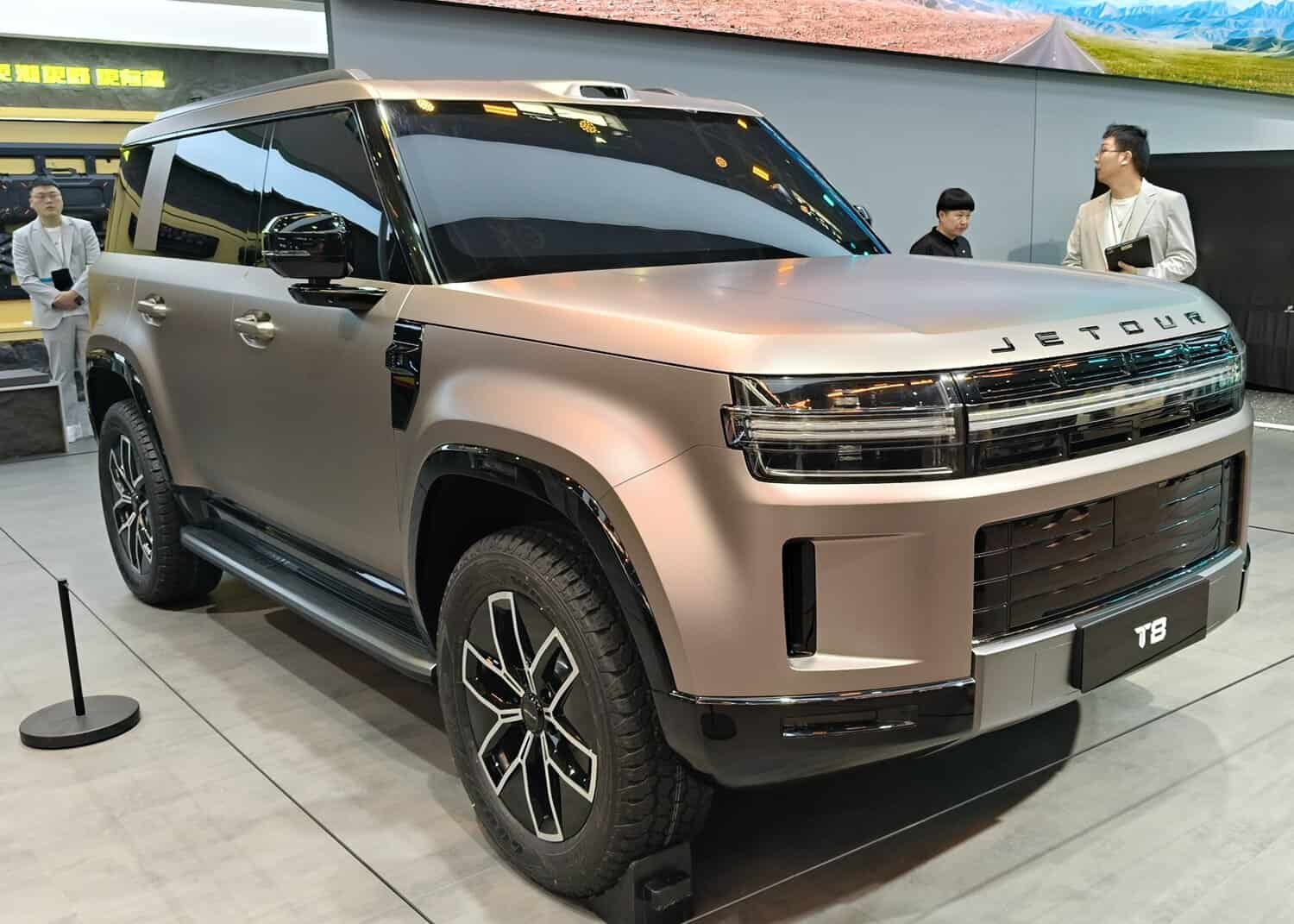
Jetour South Africa has confirmed that the T8, a three-row seven-seater SUV, will arrive in the local market in 2027, extending the Chinese brand’s rapidly expanding product range into the most hotly contested segment of the South African passenger vehicle market.
South Africa — three-row SUV segment: Jetour T8 vs key rivals (2026/27)
| Model | Origin | Entry price (SA) | Powertrain | Key notes |
|---|---|---|---|---|
| Jetour T8 (incoming) | China | TBC (est. ~R650–700k) | 2.0T petrol / PHEV | 7-seat, 3-row, 265kW PHEV option; 1,300km+ range |
| Toyota Fortuner | SA-built | From R685,900 | Diesel / Petrol | Segment leader; ~9,049 units in 2025; no hybrid |
| Ford Everest | Thailand | From R953,000 | Diesel / Petrol | 3,444 units in 2025; refreshed model arriving mid-2026 |
| Isuzu MU-X | Thailand | From R752,300 | Diesel | Diesel-only; strong towing and off-road credentials |
| GWM Tank 300 | China | Est. ~R700k+ | Petrol / Diesel / HEV | Hybrid option available; growing local presence |
| Jetour T2 (current) | China | From R569,900 | 2.0T / PHEV | 5-seat; 2026 SA Car of the Year; 5,000+ units in 6 months |
Sources: Jetour SA; NAAMSA
The T8 was first shown publicly at the Beijing Motor Show in May 2026, where it appeared in near-production form with blacked-out windows suggesting the interior had not been finalised. Jetour presented the model as the flagship above the T2, with a three-row layout and what was described as a more off-road-oriented drivetrain compared to its stablemates. The South African confirmation follows that debut and signals the brand’s intent to move upmarket from the five and seven-seat models that have driven its initial local growth.
On powertrain, pricing has not been confirmed, but the technical architecture is already established. The T8 is expected to offer a turbocharged 2.0-litre petrol engine producing 180 kW and 375 Nm as the entry-level option, paired with a seven-speed dual-clutch transmission driving all four wheels. A plug-in hybrid derivative is also expected, drawing on the same 1.5-litre turbocharged PHEV system used in the T2 i-DM, producing 265 kW and 610 Nm through a dedicated single-speed hybrid transmission with a claimed combined range exceeding 1,300 km. That PHEV powertrain, if confirmed for the T8 at a competitive price point, would represent a significant technical advantage over most established rivals in the three-row segment, none of which currently offer a plug-in hybrid option in South Africa.
The market Jetour is entering with the T8 is dominated by a small number of well-entrenched models with deep brand loyalty. The Toyota Fortuner remains the segment leader by a considerable margin, selling just under 9,050 units in 2025 and retaining first place despite a 15.2% year-on-year decline — a figure that still placed it comfortably ahead of the Toyota Land Cruiser Prado, Ford Everest, and Isuzu MU-X. The Fortuner starts from R685,900 in its base 2.4-litre diesel configuration, rising to just over R1 million for the top-specification GR-Sport variant. The Ford Everest, currently priced from R953,000 and due a mid-cycle refresh in the second half of 2026, has grown its sales 10.8% year on year to 3,444 units but remains priced well above the level at which Chinese brands typically enter. The Isuzu MU-X, starting from R752,300, rounds out the traditional podium.
At its current pricing, the Jetour T1 starts from R514,900 and the T2 from R569,900, making both models meaningfully cheaper than the established segment benchmarks despite offering comparable or superior specification in several areas. If the T8 follows a similar pricing philosophy relative to the T2 — as the X70 Plus and T-Series models have done in their respective segments — it could land in the R650,000 to R750,000 bracket, positioning it directly beneath the Fortuner’s entry price while offering hybrid power that no direct rival currently provides locally.
The speed of Jetour’s South African growth provides context for the T8’s ambitions. Monthly sales grew from approximately 400 units in late 2024 to over 1,700 units more recently, with total T-Series sales exceeding 5,000 units within six months of the T1 and T2 going on sale in October 2025. The T2 reached the position of eighth-best-selling passenger car in South Africa in its peak month, which also made Jetour the eleventh-best-selling vehicle brand overall once light commercial vehicles are included. The T2 won the 2026 South African Car of the Year award — a recognition that validated the brand’s credibility with local automotive media and has reinforced consumer confidence in the marque’s product quality.
South Africa was confirmed as the first right-hand drive market in the world to receive the Jetour PHEV products — a strategic designation that reflects both the commercial significance of the South African market to Jetour’s international rollout and the brand’s confidence in local consumer appetite for electrified drivetrains. That appetite has grown materially in 2025 and 2026 as fuel prices have remained elevated and consumer awareness of PHEV running costs has increased.
At the Beijing Motor Show in April 2026, Jetour International president Ke Chuandeng confirmed plans to assemble vehicles in South Africa at Chery’s new local factory — a development that would lower import costs and potentially allow further price reductions over time, while also qualifying locally assembled vehicles for fleet procurement programmes that favour domestically produced goods.
The broader Chinese SUV expansion in South Africa is accelerating across multiple brands simultaneously. GWM’s Tank 300, Chery’s Tiggo 9 PHEV, and BYD’s expanding SUV line-up are all competing for share in segments previously dominated by Japanese and European manufacturers. Chinese brands including Chery, Haval, BYD, and Omoda are reshaping the market with aggressive pricing and feature-rich specification, forcing legacy manufacturers to respond — whether through feature upgrades, price adjustments, or accelerating their own electrification timelines. The T8’s arrival in 2027 will add a three-row PHEV to that competitive pressure at a price point where most established rivals offer only diesel or petrol powertrains, and where the combination of space, technology, and hybrid efficiency has no direct local equivalent.