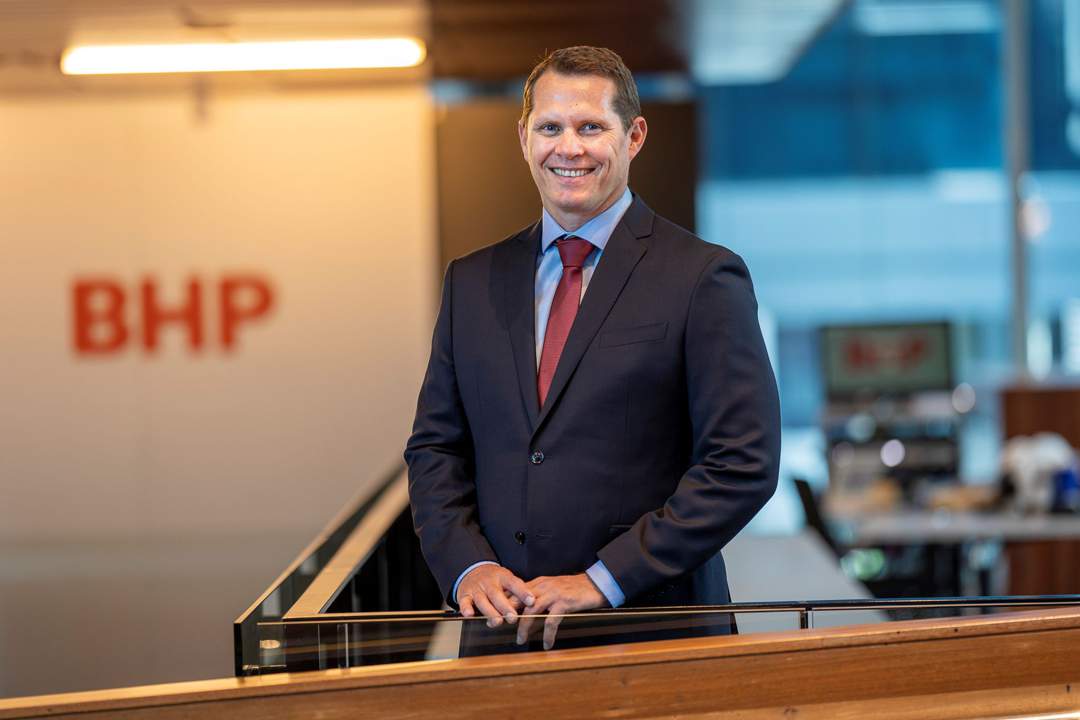
BHP, the world’s largest mining group, has named Brandon Craig as its next chief executive officer, effective 1 July 2026. Craig, currently the group’s President Americas, will succeed Mike Henry, who steps down after six and a half years in the role. The appointment signals a clear strategic direction: BHP’s next phase of growth will be driven by copper and potash assets concentrated in Canada, the United States, and South America.
Craig joined BHP in 1999 and has accumulated more than 25 years of operational and corporate leadership experience across the group. Before assuming the Americas presidency in March 2024, he led BHP’s Western Australia iron ore business, where he improved operational performance and helped consolidate BHP’s position as the lowest-cost, highest-margin major iron ore producer in the world. That operational background matters in a group where cost discipline has been as central to shareholder returns as commodity prices. During Henry’s tenure, BHP delivered average total shareholder returns of approximately 17% per annum and returned around $80 billion to shareholders — a benchmark Craig will be expected to sustain.
Henry will remain in the CEO role until 30 June 2026 and will then support the transition through to 30 November 2026, when his employment formally ends. He will not receive a 2026 long-term incentive award.
The handover is structured to preserve continuity at a moment when several major capital projects are in motion simultaneously. Craig’s annual base salary has been set at $1.9 million, with cash and share awards potentially reaching $6.8 million annually and long-term incentive share awards of up to $3.8 million per year.
The strategic rationale behind Craig’s appointment is straightforward. Under his watch in the Americas, BHP advanced growth options in copper, extended production guidance at Escondida — the world’s largest copper mine — and moved forward with the Vicuña joint venture, a project the company believes has the potential to become one of the world’s leading copper and gold mines. BHP has also overseen non-operated joint ventures in Brazil, Peru, and the United States, including the Antamina copper and zinc mine in Peru, one of the world’s largest polymetallic operations. BHP is targeting approximately 2.5 million tonnes of copper equivalent production per year by the mid-2030s.
The copper thesis underpinning Craig’s appointment is driven by structural demand, not cyclical pricing. Demand for copper is projected to increase by 40% over the next 15 years, driven by electric vehicle manufacturing, AI data centre construction, and ongoing industrialisation across emerging markets. More than half of BHP’s recent first-half earnings already came from copper — a notable shift for a group long defined by iron ore. That rebalancing accelerated under Henry, who oversaw the exit from petroleum, the simplification of BHP’s dual-listed corporate structure, and a deliberate pivot towards what the group calls future-facing commodities.
Potash is the second pillar of that pivot. BHP’s Jansen project in Saskatchewan, Canada, is set to begin first production in mid-2027, with an annual output of approximately 4.15 million tonnes. The project carries underlying EBITDA margins estimated at between 63% and 64%, and at consensus commodity prices, BHP expects Jansen to reach breakeven between 11 and 15 years after first production. The long payback period reflects the scale of the capital commitment, but BHP has anchored the rationale in long-run demographics: the global population is projected to reach 9.7 billion by 2050, driving a 70% increase in demand for potash as agricultural output is constrained by limited arable land.
Henry’s departure follows BHP’s failed attempt to acquire Anglo American in late 2025. BHP made a last-minute intervention to prevent Anglo American from pursuing a combination with Canada’s Teck Resources, only to withdraw its bid three days later. The episode drew attention to the consolidation pressures building across the global mining sector, where access to large, long-life copper deposits has become a primary strategic objective for every major producer. As detailed on BHP’s official media centre, BHP chair Ross McEwan, the former NatWest chief executive, described Craig’s appointment as the outcome of a formal succession process and expressed confidence in his capacity to execute the group’s strategy and advance its pipeline of growth projects.
For BHP, the message embedded in this appointment is deliberate. A CEO drawn from the Americas, with deep operating experience in copper and a direct role in advancing Jansen and Escondida, sends a clear signal about where the group expects its next decade of value creation to come from. Iron ore will continue to fund the balance sheet, but copper and potash are the growth story — and Craig, more than any other internal candidate, has been closest to both.