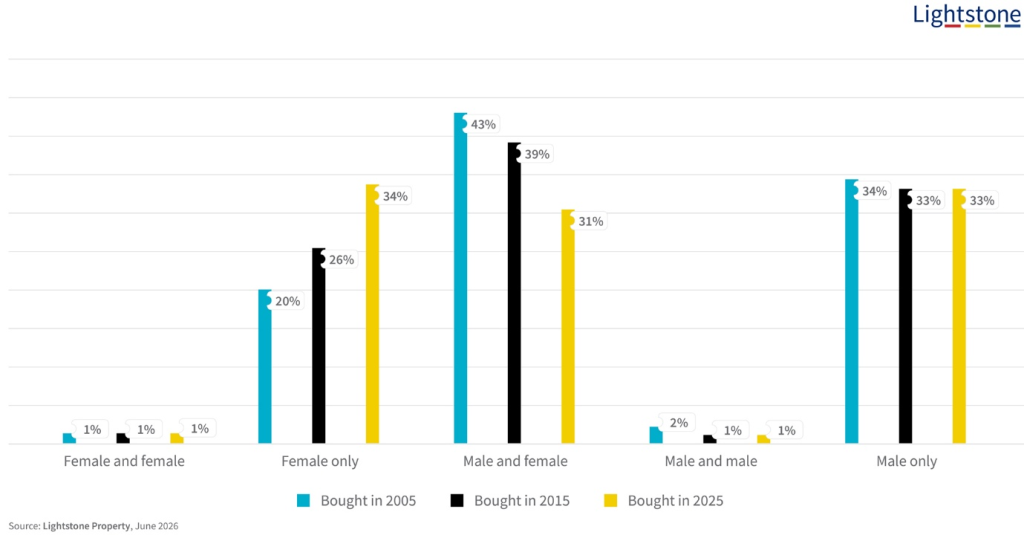
Individual women and black buyers made up a growing share of young residential property buyers in South Africa over the last 20 years, even as the under-35 market shrank and both homeowners and the broader population aged.
Stagnant wages, high levels of youth unemployment, and rising living costs have squeezed disposable income. High house prices and stricter mortgage requirements, combined with elevated interest rates, have exacerbated affordability issues
Tougher times for young buyers globally too
The shifts in South Africa have been felt globally too, and Lightstone will explore this more fully in future newsletter editions. Young adults in many markets had access to easier credit around 2005, and rising homeownership was seen as a normal early-adulthood milestone. But by 2025, fewer under-35s were buying homes.
Rising housing costs outpaced typical earnings because supply failed to keep up where demand concentrated, real incomes for many households stagnated, and capital flows and policy settings amplified price inflation, making homeownership and independent living much harder for under 35s than for previous generations.
Property market shifts in South Africa
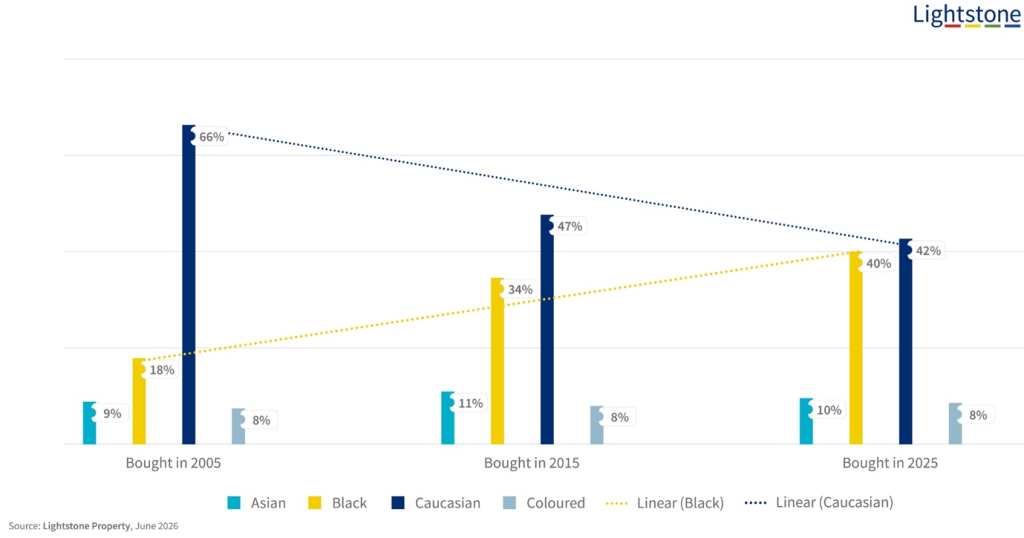
Black property buyers under-35 have more than doubled in the last 20 years while the percentage of white buyers under-35 has dropped by a third. On current trends, black buyers under-35 will shortly outnumber their white counterparts as buying patterns increasingly align with demographic numbers.
“The data on young buyers reinforces a point made recently by our MD, Sara Winstone – that the affordable housing gap, the title deeds backlog and household incomes have not kept pace with property prices,” says Hayley Ivins-Downes, Managing Executive: Real Estate Services at Lightstone. “As Sara noted, this is a policy, infrastructure and economic problem, but data could help by making the gaps visible enough that capital, policy and development can be pointed at them with real conviction.”
Under 35-year old buyers by race: 2005 – 2025
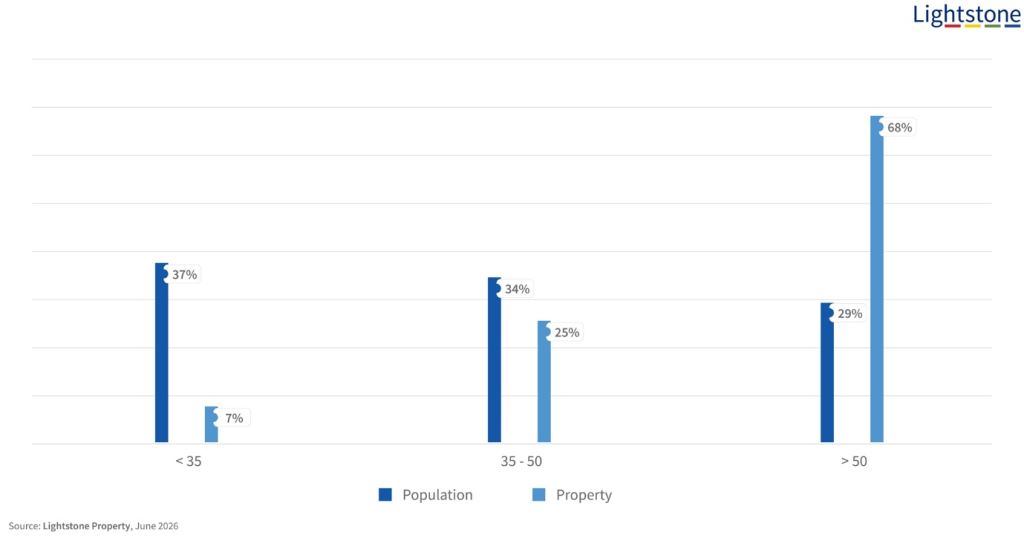
While younger black buyers will dominate this age category in the next year or two, buyers under-35 made up just 7% of property owners in 2025 despite accounting for 37% of the population.
On the flip side, property owners over-50 accounted for 68% of properties owned, although they made up 29% of the population, reinforcing the perception that policy adjustments are needed to bolster younger buying patterns.
Population percentage versus property ownership percentage by age group: 2025
Covid left a clear mark on South Africa’s economy and residential housing market. Transaction volumes fell sharply during lockdown, with recovery beginning in late 2020.
However, that recovery was uneven, strongest in middle-to-upper segments and well-located suburban markets. For younger buyers, the pressure remained significant: incomes were under strain, credit conditions tightened and affordability worsened, contributing to the decline in under-35 purchasing activity shown in the graph below.
Impact of Covid on property buyer under 35: 2015 – 2025

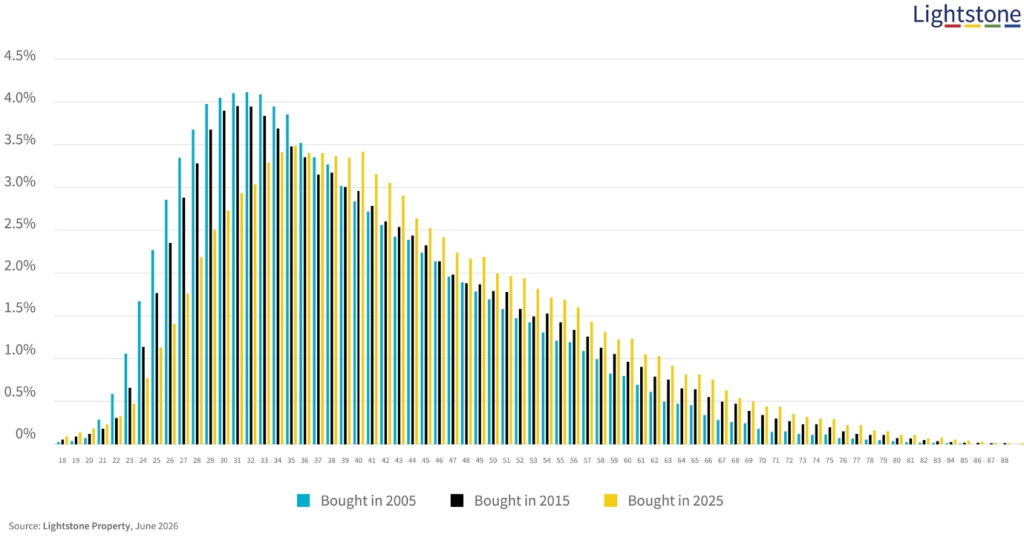
The graph below shows the age distribution of buyers over the last 20 years and the shift away from younger buyers is strikingly evident. In 2005 younger buyers made up the hump in the front of the graphic but by 2025 the age distribution had spread towards the back end.
Age distribution of buyers: 2005 – 2025
Young buyers falling as % and in absolute terms
Buyers under-35 have fallen from 44% of all buyers to 30% in just 20 years, while buyers over-35 have jumped from 55% to 71%.
Age of buyers as a percentage of total: 2005 – 2025

Not only have the proportion of sales to younger buyers dropped, but in terms of absolute volumes it has dropped even more significantly. Buyers <30 have dropped from 58 600 in 2005 to 21 300 in 2025, while the number of buyers between 31-35 fell from 49 000 to 24 200 – in both cases a fall of more than 50%.
Absolute volumes dropping: 2005 – 2025

Women going it alone
“The data also points to women under 35 increasingly buying houses on their own. In 2005, women-only purchases accounted for 20% of transactions, but this had risen to 34% in 2025, while women-men combination buys dropped from 43% to 31%. Men only acquisitions remained stable at 33%”, says Ivins-Downes.
Gender of under 35-year old buyers: 2005 – 2025