The pandemic gave us Zoom. The post-pandemic hangover is giving us something far more interesting; a corporate exodus from the screen and a full-throated return to physical, immersive, face-to-face strategy sessions. And if the data is anything to go by, this isn’t nostalgia – it’s neuroscience.
For a brief, chaotic moment in the early 2020s, it seemed the corporate world had solved the meeting problem. You didn’t need to fly executives across the country, book a venue, or arrange catering. You just needed a broadband connection and a ring light. Zoom, Microsoft Teams, and a host of digital collaboration tools promised a frictionless future where billion-rand decisions could be made from a spare bedroom and company culture could be maintained via a shared Slack channel. For a while, businesses believed them.
But 2026 tells a different story.
Hybrid work remains the dominant model – 64% of professionals globally operate in some version of it – but cracks have started to show in the digital-first philosophy that underpinned it. Microsoft’s Work Trend Index, one of the most closely watched barometers of corporate behaviour, reveals that 43% of business leaders identify relationship-building as the single greatest challenge in hybrid working environments. Not productivity. Not technology adoption. Relationships. The thing that no software update can fix.
The result has been a quiet but decisive counter-revolution. CEOs and strategy teams are not abandoning hybrid work altogether – the economics of remote flexibility are too compelling – but they are drawing a distinction between the work that can be done on a screen and the work that cannot. Routine updates, progress reports, and project check-ins; fine for Zoom. High-stakes pivots, culture-building, complex innovation, and trust-forging; increasingly, leaders are calling for these to happen in person.
The question is no longer whether to meet physically. It is where.
And here, too, the corporate world is making a statement. Sterile city conference rooms with windowless boardrooms, recycled air, and corporate carpets are being scrutinised. The emerging preference, backed by a growing body of environmental psychology research, is for venues that do something convention centres never could: actively improve the brain.
The science is striking. A global study of 7,600 office workers across 16 countries – The Human Spaces Report – found that employees working in environments with natural elements such as light, plants, and water reported a 15% higher sense of wellbeing, a 6% boost in productivity, and a 15% increase in creativity compared to colleagues in conventional urban office settings. Even more compelling is research from the Harvard T.H. Chan School of Public Health, which found that employees working in high-oxygen, outdoor-rich air environments achieved cognitive function scores 61% higher than those in standard office conditions.
This is the premise on which Kruger Gate Hotel, positioned at the boundary of Kruger National Park on the banks of the Sabie River, has built its conferencing offering. The hotel’s General Manager, Miguel Farinha, is direct about what the market is now asking for. “Digital fatigue has become the silent killer of corporate innovation,” he says. “Leaders are realising that while you can manage a project on a screen, you can’t forge a culture or navigate a high-stakes pivot in two dimensions. Business in 2026 is about returning to a state of presence.”
The hotel’s conference infrastructure is substantial, offering four separate rooms equipped for various setups. These are not rustic bush shelters with temperamental Wi-Fi. They are fully equipped, high-spec meeting environments – but positioned where the Sabie River moves through the trees and hippos surface on the bank.
“For businesses where the pressure to innovate is relentless, the physical environment of a conference is essential, ensuring executives are able to do deep thinking with total clarity rather than the feeling of lingering burnout,” says Farinha.
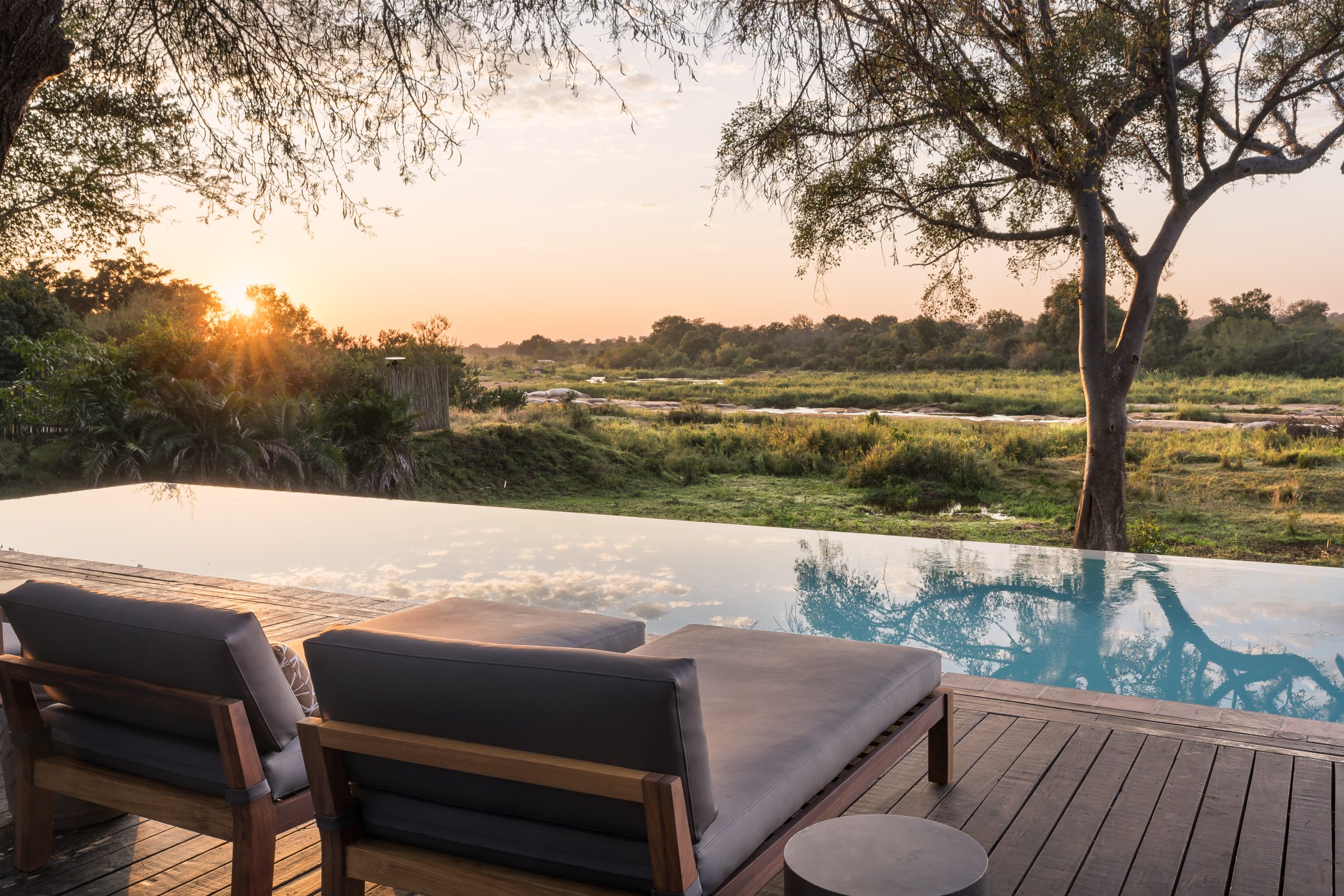
The experience at Kruger Gate Hotel is designed as a continuous recalibration of both attention and energy, beginning the moment guests wake to the natural soundscape of the Sabie River. After a sumptuous breakfast, the rhythm of the day shifts into structured conferencing, but never at the expense of environment or pause. Meetings are punctuated by breaks in the outdoors, a walk to admire the riverfront views or sitting at the infinity-edge pool deck area.
“The question for 2026 is no longer ‘Can we do this on Zoom?’ but rather ‘Can we afford not to do this in person?’,” states Farinha. “For the sectors that move the needle of the South African economy, the answer is increasingly clear. Real strategy requires real presence. And there is no place more present than the edge of the wild.”
Online meetings are not dead. But for work sessions that genuinely matter, the smartest companies in South Africa are stepping away from their screens – and into the bush.