
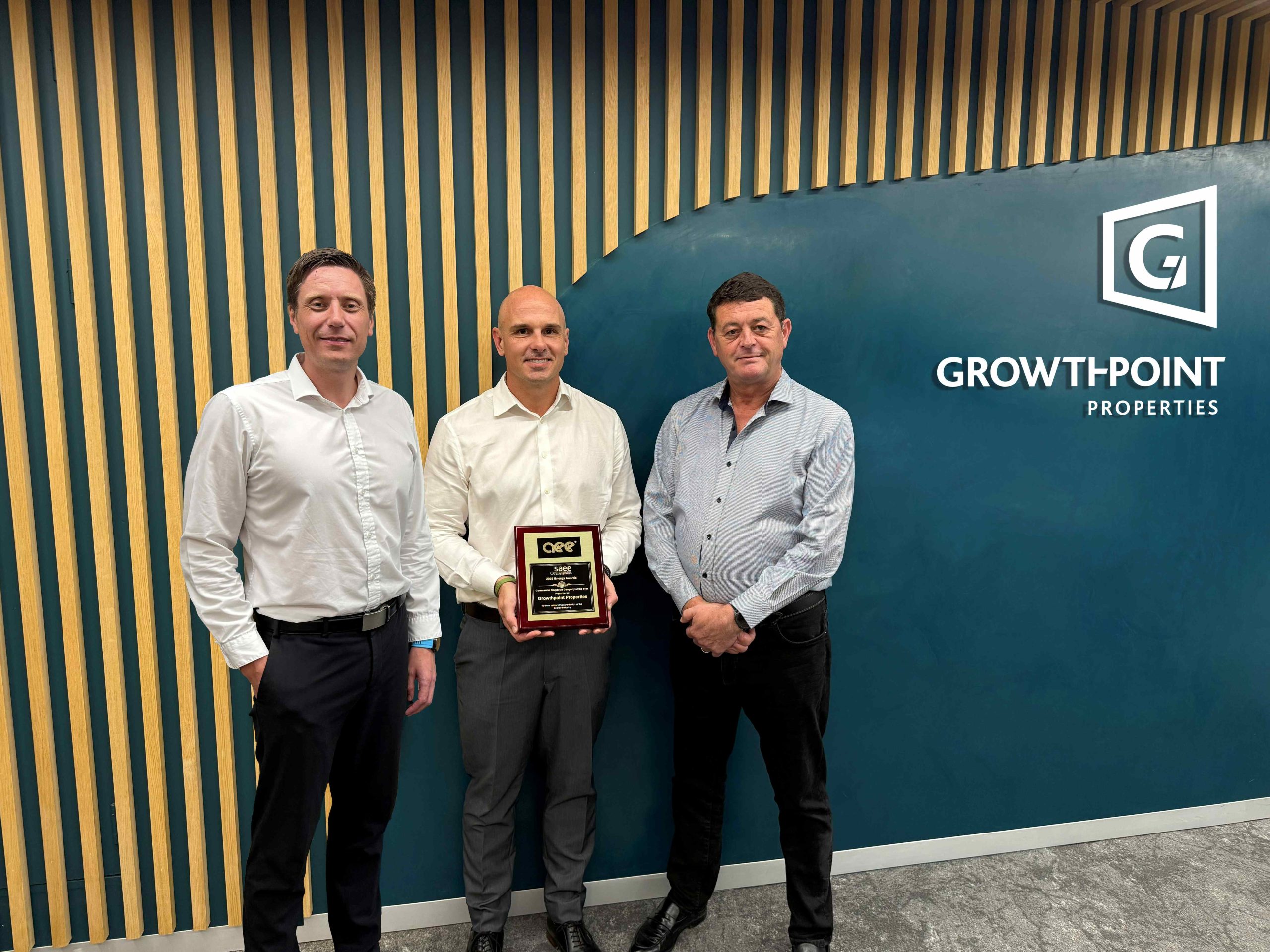
Growthpoint Properties (JSE: GRT) has been named Commercial Corporate Company of the Year at the South African Energy Efficiency Confederation (SAEEC) Energy Awards 2026 for its integrated renewable energy ecosystem, which has measurable impacts and benefits that extend well beyond its properties and business.
The award recognises a new model that combines renewable energy generation, wheeling, digital carbon accounting and shared benefits for clients in Growthpoint’s property portfolio.
The awards were announced on 28 October 2026 at the Association of Energy Engineers Energy (EEA) Conference at the Two Oceans Aquarium at the V&A Waterfront in Cape Town. They recognise leadership and innovation that deliver measurable improvements and outstanding contributions to the energy industry.
“We are honoured to receive this award, which recognises the ground-breaking work of our teams and partners in creating a pioneering renewable energy ecosystem. They have built something completely new for South Africa and established a proven model that opens the door for more organisations, public and private, to access electricity from renewable sources, reduce carbon emissions and verify their progress,” says Estienne de Klerk, Group CEO of Growthpoint Properties.
In a highly competitive property market, most businesses guard an innovation that gives a business an edge. Growthpoint took a different view. From the outset, it invested in developing an energy ecosystem that others could replicate, with the intention of extending its benefits beyond its own portfolio to provide value to its clients.
“The opportunity is bigger than our own business. Growthpoint, with our partners, has created an energy ecosystem blueprint that was designed to be adopted by the wider market to help more organisations make the transition to renewable energy. We are delighted that this achievement has been recognised with a prestigious SAEEC Energy Award,” adds Werner van Antwerpen, Head Corporate Advisory at Growthpoint Properties.
Hydropower anchors the ecosystem
The anchor of Growthpoint’s expanding multi-source energy ecosystem is the Boston Hydroelectric Plant, a 5MW run-of-river facility on the Ash River in the Free State. Developed by independent power producer Serengeti Energy, the plant began commercial operations in October 2025.
The facility operates at a capacity factor of between 78% and 82%, with a first year annual generation of more than 30GWh of clean electricity. It connects renewable energy generation with verification, carbon accounting and measurable value for clients.
The project has avoided approximately 27,000tonCO₂e[1] in its first full year of operation.
Scaling renewable energy across properties
Electricity from the plant is wheeled through the national grid under Growthpoint’s long-term power purchase agreement (PPA) with Etana Energy. From April 2026, as part of a pooled wheeling pilot project, some of the electricity generated was also allocated across commercial, retail and industrial properties connected to the City of Cape Town distribution networks.
This ability to supply properties across different municipal distribution networks addresses a longstanding barrier to renewable energy adoption in urban property portfolios.
“The rapid expansion from 20 participating properties when we started wheeling in October 2025 to 43 from August 2026 demonstrates that pooled wheeling is commercially and operationally viable at scale across multiple utility networks,” says Marius Meyer, Head of Energy at Growthpoint Properties.
The project has established several important market milestones. It demonstrated how renewable electricity supplied under a single power purchase agreement from a single source can serve multiple buildings and customers across a diversified property portfolio. It also laid the foundation for the first pooled wheeling pilot within the City of Cape Town distribution network, launched in April 2026 with five properties and later extended to an additional 17 properties.
The initiative further marks the first successful implementation of portfolio-based renewable energy allocation across both Eskom and municipal distribution networks. Importantly, pooled wheeling pilot enabled Growthpoint to expand its wheeled renewable energy supply beyond hydropower, allocating electricity from a wind energy facility in Mpumalanga to the 17 additional properties in the pooled wheeling programme. Growthpoint’s collaboration with Etana and the City of Cape Town has created a scalable blueprint for other municipalities to follow, helping to remove barriers to wheeling and accelerate renewable energy adoption across South Africa.
Verifying renewable energy use
To support the integrity of renewable energy claims, Growthpoint partnered with Fuel Switch to introduce a blockchain-enabled digital platform that matches electricity consumption with Renewable Energy Certificates (RECs) on an hourly basis.
On 30 September 2026, two years since registering its first renewable energy system for RECs, Growthpoint had generated 69,613 certificates. Of these, 6,670 have been transferred to clients to support their Scope 2 decarbonisation objectives, while Growthpoint has redeemed 50,345 to support green building certifications and reduce their own Scope 2 emissions reductions.
Direct benefits for clients
Building on this renewable energy and digital infrastructure, Growthpoint’s e-CO₂ client solution allocates certified environmental attributes directly to our e-CO2 buildings. This enables clients to benefit from measurable carbon reductions without on-site renewable electricity generation infrastructure.
The programme also passes some of the wheeling savings to its clients by calculating a green benefit credit, which reflects on their rental invoice, providing greater cost certainty for Growthpoint clients alongside carbon reduction benefits.
The e-CO₂ programme is active in nine buildings within Growthpoint’s broader wheeling portfolio of 43 buildings.
“Growthpoint’s renewable energy ecosystem approach has leveraged the collective demand of our buildings and clients to turn new possibilities into practical commercial solutions,” concludes de Klerk.