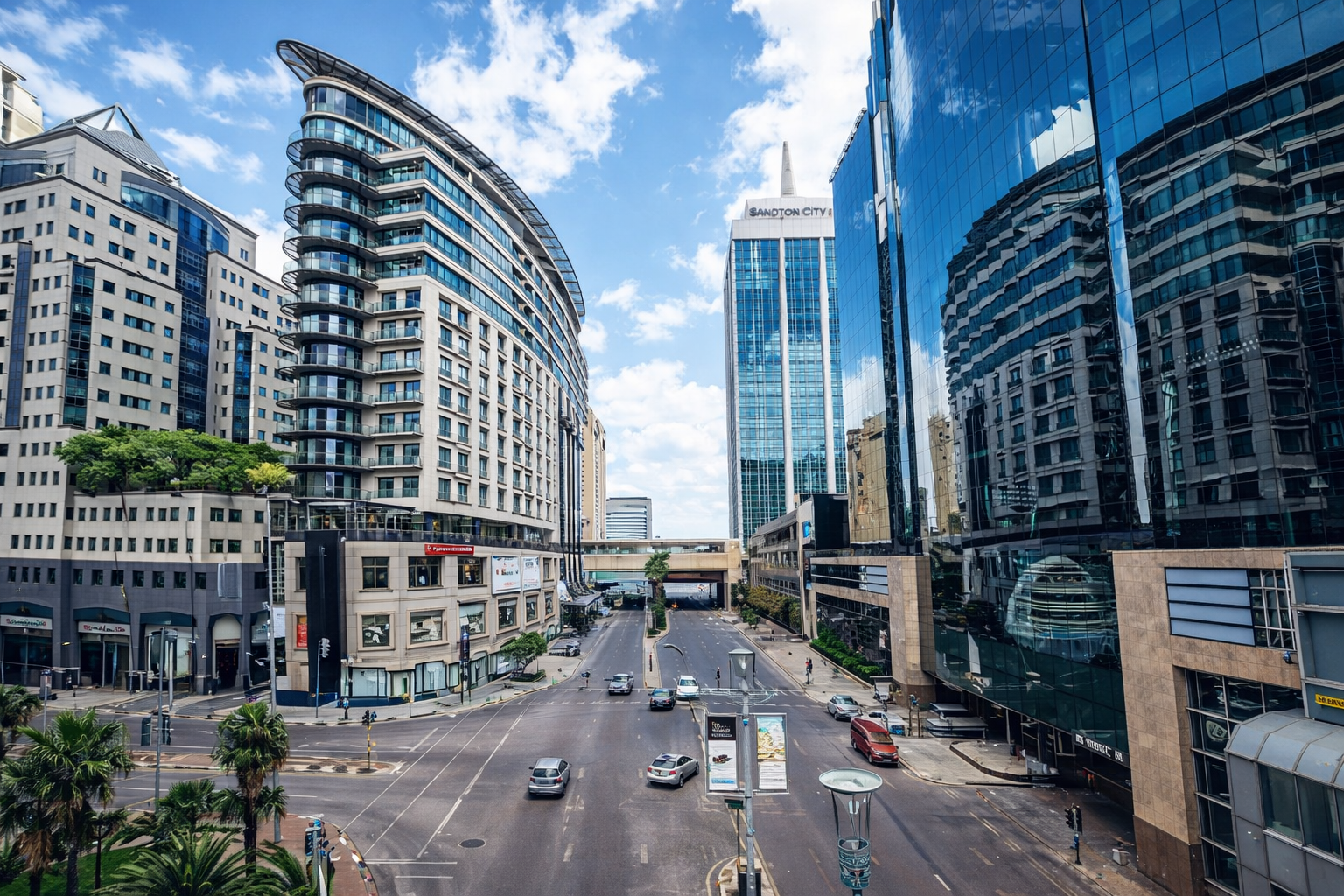
South Africa’s retail property sector posted real growth in the first quarter of 2026, with large destination malls and Gauteng shopping centres emerging as the standout performers — a meaningful rotation from the trend of the previous 18 months, in which smaller community centres and the Western Cape had consistently led the field.
Clur Shopping Centre Index — Q1 2026 key data
| Segment / Province | Trading density (R/m²) | YoY growth |
|---|---|---|
| By centre format | ||
| Super-regional centres (100,000m²+) | R53,225 | +5.6% |
| Regional centres | — | +5.4% |
| All centres (national) | R43,340 | +5.2% |
| Community & smaller centres | R49,131 | +4.9% |
| By province (Q1 2026) | ||
| Western Cape (volume leader) | R50,262 | +5.2% |
| Gauteng (growth leader) | R41,842 | +5.6% |
| KwaZulu-Natal | R45,278 | +4.4% |
| Provincial context (Q1 2024 baseline) | ||
| Western Cape (Q1 2024) | R45,460 | +8.2% (then-leader) |
| Gauteng (Q1 2024) | R40,348 | +5.9% (below WC) |
| KwaZulu-Natal (Q1 2024) | R42,676 | −2.4% |
Sources: Clur Shopping Centre Index Q1 2026; Clur International
The national Clur Index for All Centres closed Q1 2026 at an annualised trading density of R43,340 per square metre, with year-on-year growth of 5.2% — outperforming March 2026 CPI by 2.1 percentage points. That real growth figure is significant in the context of an economy where consumers have been navigating elevated interest rates, persistent food inflation, and a labour market that has failed to generate meaningful formal employment at scale.
The most notable shift in Q1 was in centre format performance. Super-regional centres — those exceeding 100,000 square metres of gross lettable area — recorded year-on-year trading density growth of 5.6%, marking the first time since November 2024 that they had outperformed community and smaller centres. Regional malls followed at 5.4%. Community and smaller centres, which had led for much of 2024 and 2025 as consumers sought convenience over distance, came in at 4.9% growth — still ahead of inflation, but no longer at the top of the rankings.
Clur International managing director Belinda Clur, whose firm produces the index covering more than 5.4 million square metres of retail space across listed and unlisted property funds in South Africa and Namibia, described the result as a meaningful shift in growth across both formats and provinces. The rotation back towards destination malls reflects, in part, the gradual improvement in consumer confidence that has followed a sequence of interest rate cuts and moderating inflation from mid-2025 — conditions that encourage longer-distance shopping trips to larger centres, where discretionary categories such as fashion, homewares, and electronics tend to anchor the tenancy mix.
On the provincial front, Gauteng overtook the Western Cape as the fastest-growing retail property market in Q1 2026, recording trading density growth of 5.6% year on year. The Western Cape followed at 5.2%, while KwaZulu-Natal posted growth of 4.4%. The Gauteng result represents a structural improvement from Q1 2024, when the province underperformed the national index with a trading density of R40,348 per square metre — below both the Western Cape at R45,460 and KwaZulu-Natal at R42,676. Two years on, Gauteng’s absolute trading density remains the lowest of the three major provinces at R41,842 per square metre, but its rate of growth has overtaken its rivals for the first time in an extended period.
The Western Cape, despite ceding the top growth position, retained its status as the volume leader, with an annualised trading density of R50,262 per square metre — ahead of KwaZulu-Natal’s R45,278 and Gauteng’s R41,842. The province’s structural advantage in trading density reflects a combination of higher-income demographics in its core retail nodes, the dominance of tourism-linked spending in coastal and city-centre precincts, and a consumer base that has historically shown greater resilience during periods of national economic pressure.
The Redefine Properties portfolio provides a useful real-world illustration of the large-mall performance trend. The group, which owns several of the country’s biggest shopping destinations including Centurion Mall and Maponya Mall, reported that its annual trading density increased to R37,200 per square metre from R35,420 in the half-year period ended February 2025, with its rent-to-turnover ratio holding at 7.7% for the six months to February. A rent-to-turnover ratio below 8% is generally regarded as a healthy indicator of the relationship between occupancy costs and retail sales, suggesting that tenants in large Redefine centres are generating sufficient volume to absorb their rental obligations without significant margin pressure.
The broader retail property market enters the second quarter of 2026 supported by macroeconomic tailwinds that were largely absent two years ago. South Africa’s removal from the FATF grey list in 2025 has improved access to international capital, and most listed real estate investment trusts delivered double-digit total returns in 2025 according to multiple market assessments. Retail vacancies have been declining, with SAPOA data placing vacancy rates across major centres at 4.9% at the end of Q1 2025 — still above the 3% to 4% range generally associated with a fully absorbed market, but substantially below the 7.1% recorded at the peak of distress in March 2021. Rental growth has remained positive across all major centre formats, and the Clur Base Rent Index closed 2025 at a rent-to-sales ratio of 6.6% — described by Clur as evidence of ongoing stable and controlled market risk.
The format and geographic rotation visible in the Q1 2026 data also has implications for property fund portfolio construction. Fund managers who concentrated exposure in community centres and the Western Cape during the 2024 to 2025 period of smaller-centre outperformance now face a market in which that advantage has narrowed. Conversely, funds with significant exposure to large Gauteng malls — an asset class that was trading at a discount to Western Cape equivalents for an extended period — are benefiting from the convergence.
What the data does not yet resolve is whether Gauteng’s growth outperformance reflects a durable structural recovery in the province’s consumer economy or a cyclical bounce from a low base. South Africa’s commercial property sector entered 2026 with improved business confidence, tightening vacancies, and the first meaningful pipeline of new development activity in several years, with Growthpoint’s R20 billion V&A Waterfront expansion and Walmart’s branded-store rollout in Johannesburg cited as indicators of returning institutional commitment. Whether that commitment extends into the Gauteng retail property market at scale will depend on whether the province’s consumer spending growth proves durable beyond a single quarter.