
Healthleap, a clinical artificial intelligence (AI) company founded in South Africa, has raised $38 million (about R623 million) in combined seed and Series A funding. It will use the money to extend its hospital screening platform to more conditions.
The funding comprises an $8 million (R131 million) seed round, co-led by Sequoia Capital and First Round Capital, and a $30 million (R492 million) Series A led by Hummingbird Ventures, TechCrunch reported earlier this month. The company has not disclosed its valuation.
Siblings Josiah and Jemima Meyer founded Healthleap in 2022. It grew out of NutriLeap, a tool Jemima, a South African-registered clinical dietitian, built to help colleagues identify at-risk patients sooner. The company is now headquartered in San Francisco, and its customers are US hospital groups.
| Metric | Figure |
|---|---|
| Seed round (Sequoia, First Round) | $8m (R131m) |
| Series A (Hummingbird Ventures) | $30m (R492m) |
| Total raised | $38m (R623m) |
| Hospitals using the platform | More than 50 (three a year earlier) |
| Revenue growth over the past year | More than tenfold |
| Penn Medicine estimated annual impact | $23.8m (R390m) |
The platform reads each patient’s electronic health record every morning, including clinical notes, laboratory results, vital signs, orders and problem lists. It uses language models to extract information from unstructured notes and combines this with structured data. It then sends risk scores into the systems clinicians already use, showing care teams which patients to review first. The company says the software flags patients for review rather than diagnosing them.
Malnutrition was its first focus. Research cited by TechCrunch suggests that between 20% and 50% of hospital inpatients are malnourished, a condition linked to longer stays, poor wound healing, infections and higher mortality. Because the diagnosis affects how US hospitals are reimbursed, missed cases also mean lost revenue.
Healthleap says it now also screens for delirium. Programmes for congestive heart failure readmissions, pressure ulcers and aspiration pneumonia are undergoing further clinical validation, and hospital-acquired infections are also planned. The longer-term aim is to cover more than 40 major conditions and expand into outpatient and home care. The new capital will fund hiring across engineering, product, sales and customer success.
Chief executive Josiah Meyer said many patients leave hospital with unresolved conditions that can cost up to ten times more to treat later. He said the company’s aim is to identify those conditions while patients are still admitted.
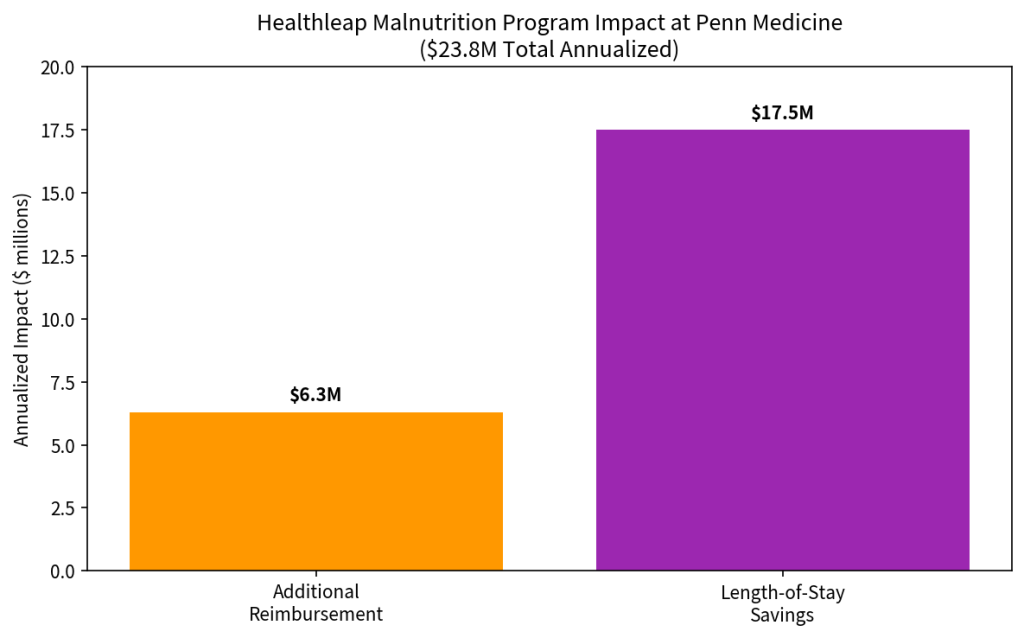
One health system recorded a 39% rise in malnutrition cases identified and treated, along with $11 million (R180 million) in additional revenue. At Penn Medicine, the company estimates an annual impact of $23.8 million, comprising $6.3 million (R103 million) in added reimbursement and $17.5 million (R287 million) from shorter stays. Healthleap says every customer has achieved at least a fivefold return on investment. These figures are reported by the company and have not been independently audited.
Sequoia partner Alfred Lin said the firm was drawn to the company’s focus on patients who are being missed. Josh Kopelman, co-founder of First Round Capital, cited its vision of every hospital using real-time AI to catch overlooked risk and recover reimbursement.
The raise is large by African standards. African start-ups raised $2.10 billion (about R34.4 billion) across 275 deals between January and August 2026, according to data compiled by Capmad. South African companies took $248.2 million (R4.07 billion) of that, so Healthleap’s round alone equals about 15% of the local total.