

In 2007, Gordon Bredenkamp drew up a design for a portable, closed water reservoir built to go where rigid tanks could not. He manufactured the first Damsak® from his base in Cullinan. Nearly two decades later, the family business he runs with his son Dawid is exporting that product across international borders.
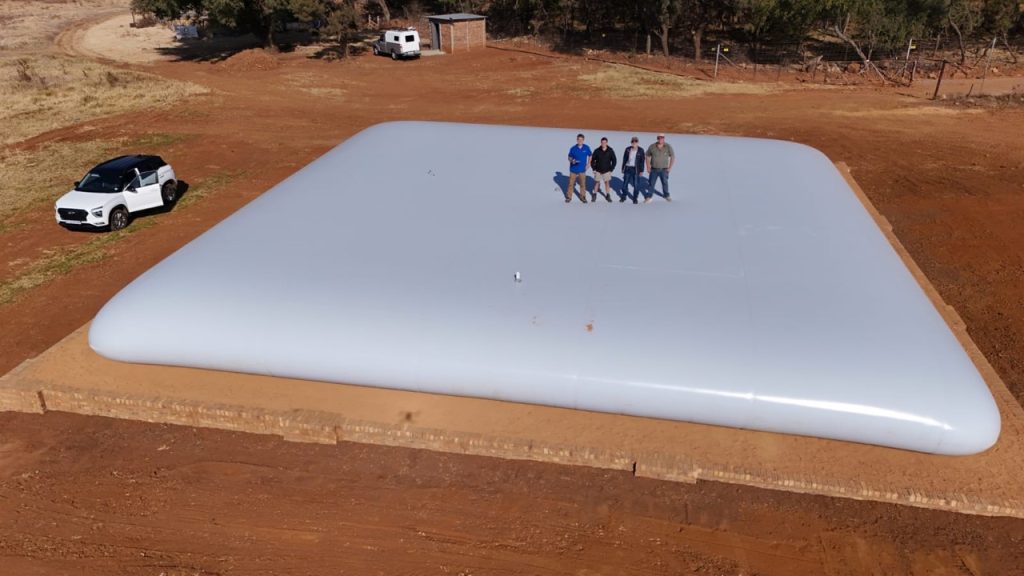
Damsak® Reservoirs has announced the expansion of its operations into international markets alongside the launch of its largest reservoir to date: a 500,000-litre water storage bladder engineered for high-demand industrial and agricultural environments. The unit ships folded, installs without heavy equipment, and collapses small enough to fit into a standard vehicle when empty.
The timing is not incidental. South Africa’s water infrastructure is under strain that goes well beyond drought. Government’s own 2026 assessments show that roughly 32 percent of all treated water leaks away before it reaches a single user, through ageing pipes and failing valves. Non-revenue water sits at 47.4 percent nationally. The Auditor-General found that municipalities lost R14.89 billion worth of treated water in a single year. Cape Town entered Early Drought Caution in October 2025, with dam levels tracking 15 percent below the previous year. The City’s Water Outlook Report warns that ageing infrastructure, changing raw water quality, and rising demand have increased the likelihood of short to medium-term restrictions. For businesses in manufacturing, food processing, agriculture, and mining, a supply failure or restriction notice does not arrive with warning. It stops operations.
For most South African businesses, the vertical plastic tank has been the default answer to water storage for decades. It is familiar and widely available. The limits become apparent at scale. The largest moulded plastic tanks on the market cap at around 20,000 litres and require a level, reinforced concrete base to carry the weight. They are permanent once placed. Moving one is not practical, and installing several to reach industrial capacity multiplies both the footprint and the civil works required.
A Damsak® bladder operates on a different principle. It stores up to 500,000 litres in a single closed unit, ships flat, and deploys on any reasonably level surface without a permanent foundation. When the site changes, it moves with the operation. For a mine managing dust suppression across shifting locations, a food producer needing flexible overflow capacity, or any business running across multiple sites, that difference is not marginal. It is the whole point.
Each Damsak® is manufactured from polyester-reinforced, food-grade plasticised PVC. The closed system prevents algae growth and water evaporation, maintaining quality without chemical treatment. Units carry a ten-year guarantee. Deployment requires no specialised crew and no permanent footprint.
“Open storage is where contamination starts. A closed system is not a feature, it is the baseline. Everything else follows from that.”
Dawid Bredenkamp, Co-founder and Director, Damsak® Reservoirs
The international expansion opens Damsak® to markets where the conditions mirror South Africa: unreliable municipal supply, ageing networks, and industrial demand outpacing infrastructure. Parts of sub-Saharan Africa, the Middle East, and South and Southeast Asia face the same gap that Damsak® has spent nearly two decades filling at home. The product travels. The problem it solves already has.
From a farm in Limpopo holding water through a drought to a food processor in Nairobi managing supply disruptions, the application is the same: store water when it is available, and use it when it is not.