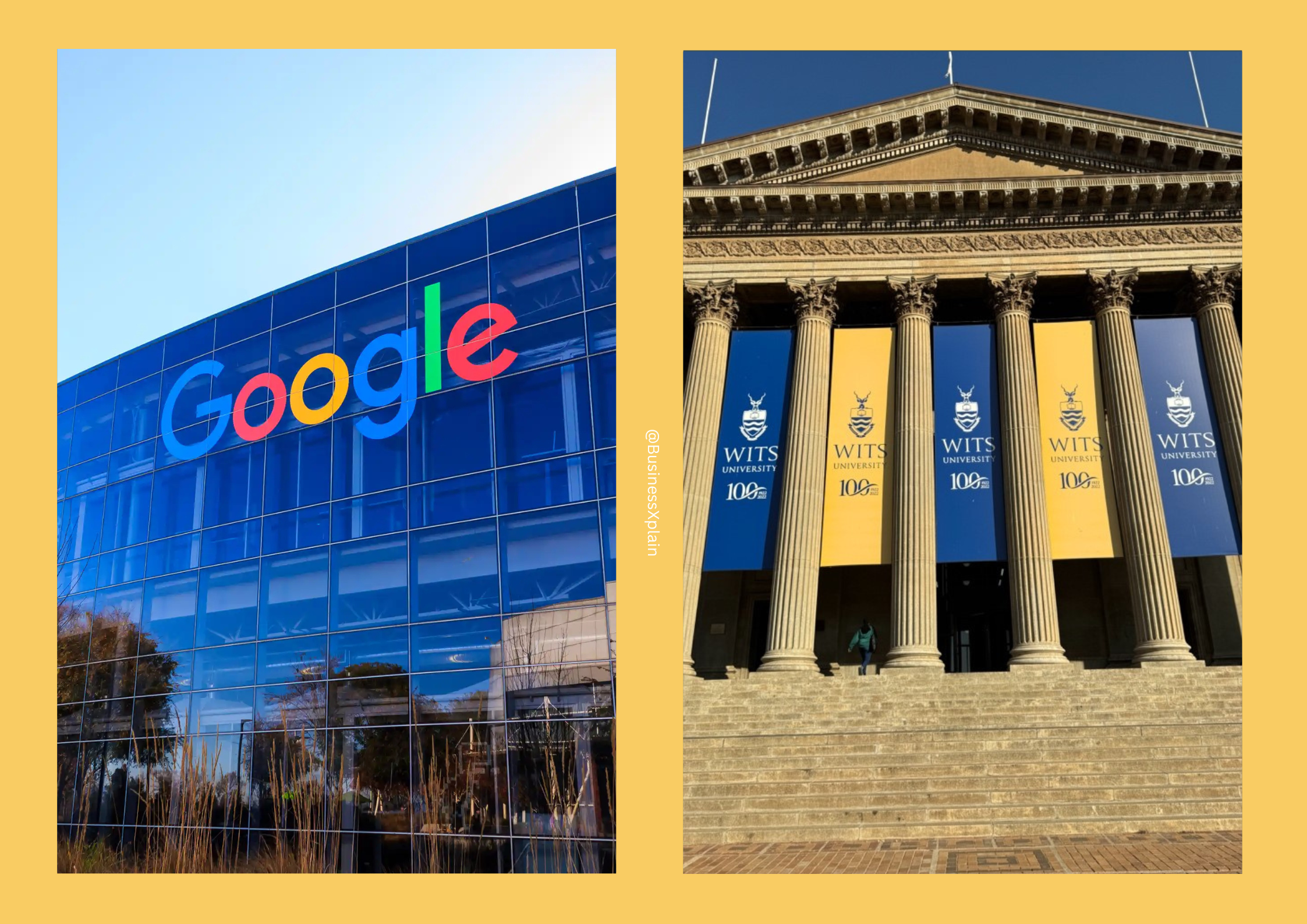
Amid severe financial strain on South African universities following sharp reductions in United States funding this year, the University of the Witwatersrand has secured a significant lifeline. The institution’s recently established Machine Intelligence and Neural Discovery (MIND) Institute has been awarded $1 million (R17 million) by Google.org, the philanthropic arm of the technology giant.
Launched only in November 2024, the MIND Institute has rapidly emerged as one of the continent’s most ambitious centres for fundamental artificial intelligence research. According to the university’s announcement, the grant will finance new research initiatives, expand postgraduate training, and strengthen Africa’s influence on the future direction of global AI development.
Leading the institute is Professor Benjamin Rosman, who was recently named among the world’s most influential AI figures in the 2025 TIME100 AI list. He emphasised that the funding represents far more than financial support; it signals international recognition of African-led scientific innovation. Rather than merely adopting tools created in Silicon Valley or elsewhere, the institute aims to generate original knowledge rooted in African perspectives and challenges.
What sets MIND apart from many other African AI programmes, which tend to focus on applying existing models to local datasets, is its commitment to exploring the underlying science of intelligence itself. Researchers from neuroanatomy, neuropsychology, philosophy, and evolutionary biology work alongside computer scientists, creating unusual but potentially transformative projects. One ongoing study, for example, examines how sleep deprivation affects both AI systems and human cognition, while another analyses elephant communication patterns to deepen understanding of non-human intelligence.
As reported by Business Day, the Google.org grant stems from years of prior collaboration between the company and Wits, but marks a deliberate shift towards backing fundamental rather than purely applied research. The money will be channelled through the institute’s MINDFund, which provides rapid seed funding for interdisciplinary proposals involving at least two fellows from different fields. This mechanism is explicitly designed to encourage risk-taking and to challenge the conservative incentives that often dominate academic research.
Student involvement remains central to the institute’s model. The new resources will enable more postgraduate researchers to participate in ambitious projects and gain exposure to multiple disciplines simultaneously. Rosman has highlighted practical applications ranging from improved medical diagnostics and agricultural logistics to climate-friendly industrial processes and enhanced school curricula, all developed with African contexts in mind.
Although headquartered in Johannesburg, MIND maintains a strongly pan-African outlook. Plans are already under way to extend its fellowship programme to scholars across the continent. Rosman himself co-founded the Deep Learning Indaba in 2017; the annual machine-learning summer school, now the world’s largest of its kind, attracted around 1,300 participants to its most recent event in Rwanda, according to TechCentral.
Wits University* statements.
Vice-chancellor Professor Zeblon Vilakazi described the Google.org investment as validation of the university’s long history of technological pioneering, stretching from Africa’s first computer to early radar development. He called MIND “a bold experiment in converging natural and artificial intelligence research” that could help place Africa at the forefront of the next technological wave.
For Rosman and his colleagues, the broader message is unambiguous: the next generation of artificial intelligence must reflect African insights and priorities if it is to serve humanity responsibly. With this substantial backing from one of the world’s largest technology companies, the MIND Institute now has the means to turn that vision into reality, ensuring the continent is not merely a consumer of AI, but one of its principal architects.