
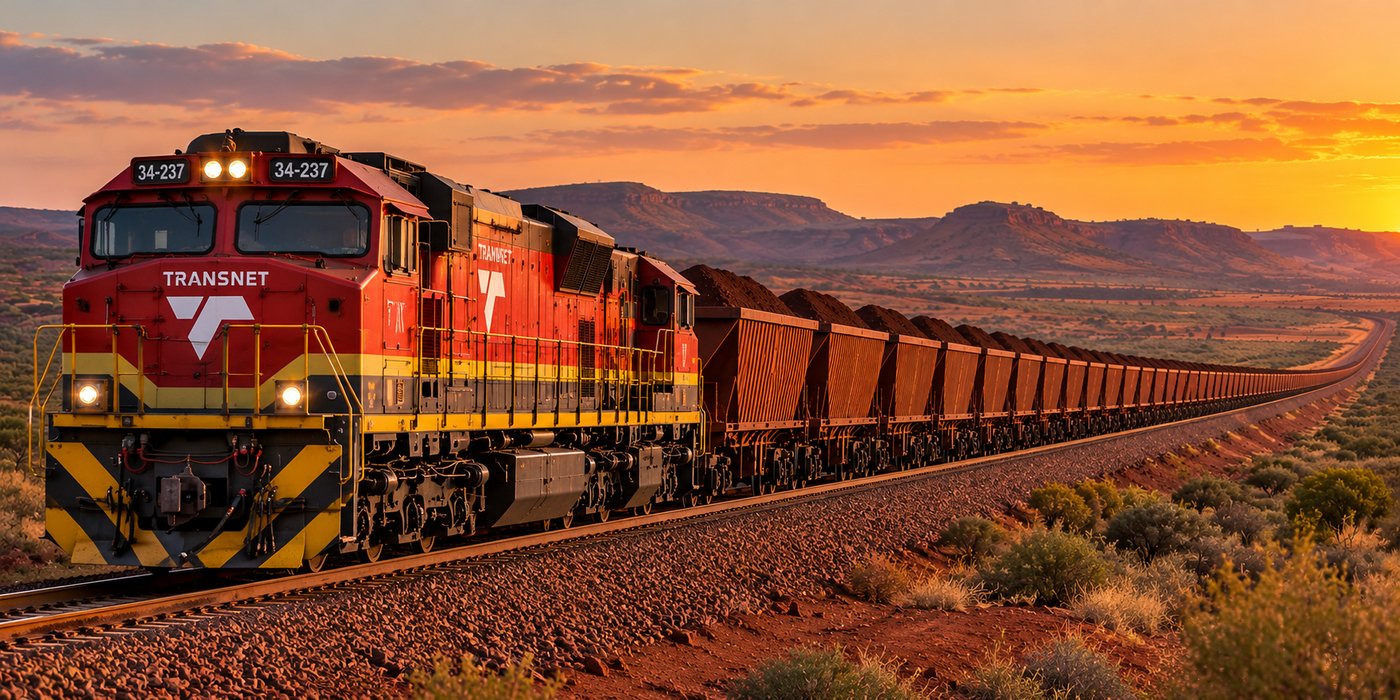
Transnet Freight Rail (TFR) has run a 7.6km freight train of 696 wagons on the Sishen–Saldanha iron ore line. The state-owned operator says it is the longest freight train ever run, a claim that would take the world record from Australia’s BHP after 25 years.
The train of empty ore wagons left Saldanha Bay on 17 October and reached Loop 18 in the Northern Cape the next day. Class 15E electric and Class 43D diesel-electric locomotives were spaced along its length. They were linked by Radio Distributed Power, which lets them accelerate and brake as one unit. Guinness World Records has not yet confirmed the run.
The previous record was set on 21 June 2001. That day BHP Iron Ore ran a 7.353km, 682-wagon train with eight locomotives from its Newman and Yandi mines to Port Hedland in Western Australia. South Africa last held the record in 1989, set on the same line.
| BHP Iron Ore (2001) | Transnet Freight Rail (2026) | |
|---|---|---|
| Country | Australia | South Africa |
| Train length | 7.353km | 7.6km |
| Wagons | 682 | 696 |
| Route length | 275km | 861km |
| Corridor volume | n/a | 52.8Mt (2025/26) |
| Licensed capacity | n/a | 60Mt a year |
TFR chief executive Russell Baatjies said the run showed the organisation’s engineering and operational capability, and that its main value lies in what the data reveals. Transnet’s train design and operations teams planned it with Transnet Engineering, the Transnet Rail Infrastructure Manager and the Railway Safety Regulator. They will now compare locomotive performance data with their pre-run simulations.
That data matters because longer trains are the cheapest way to add capacity on a single-track corridor. The 861km line carried 52.8 million tonnes (Mt) of iron ore in 2025/26, up from 50.6Mt a year earlier, against a licensed capacity of 60Mt a year. Railway Gazette reports that Transnet is seeking approval to raise that limit to 67Mt.
The test followed a maintenance shutdown from 6 to 16 October, which Transport Minister Barbara Creecy inspected. The shutdown forms part of an R8.9bn restoration programme running to 2030, of which R3.4bn comes from National Treasury’s Budget Facility for Infrastructure. Separately, Transnet National Ports Authority is spending R750m on an electrical upgrade at Saldanha to power a third tippler, the machine that empties wagons at the port.
The line’s main customer is under pressure. Kumba Iron Ore said on 20 October that volumes railed to Saldanha fell 8% in the third quarter, partly because a derailment cost about 400,000 tonnes. Over nine months Kumba’s realised price averaged $86 (R1,413) a tonne, down from $94 (R1,544) a year earlier. Sea freight from Saldanha to Qingdao reached $32 (R526) a tonne in September, a five-year high.
Kumba also reported that Transnet has completed a third of its 517km rail replacement programme on the corridor. That work underpins any move to run longer trains as a matter of routine.
Across its whole network, Transnet chief executive Michelle Phillips has said freight rail volumes reached about 167.9Mt last financial year, with 180Mt set as the next milestone. Government’s target is for rail to carry 250Mt by 2029, more than 80Mt above current levels with about three years left.