

Finance Minister Enoch Godongwana has lowered South Africa’s growth forecast for 2026. He nonetheless told Parliament that the public finances have turned a corner, with debt stabilising and the budget deficit narrowing faster than expected.
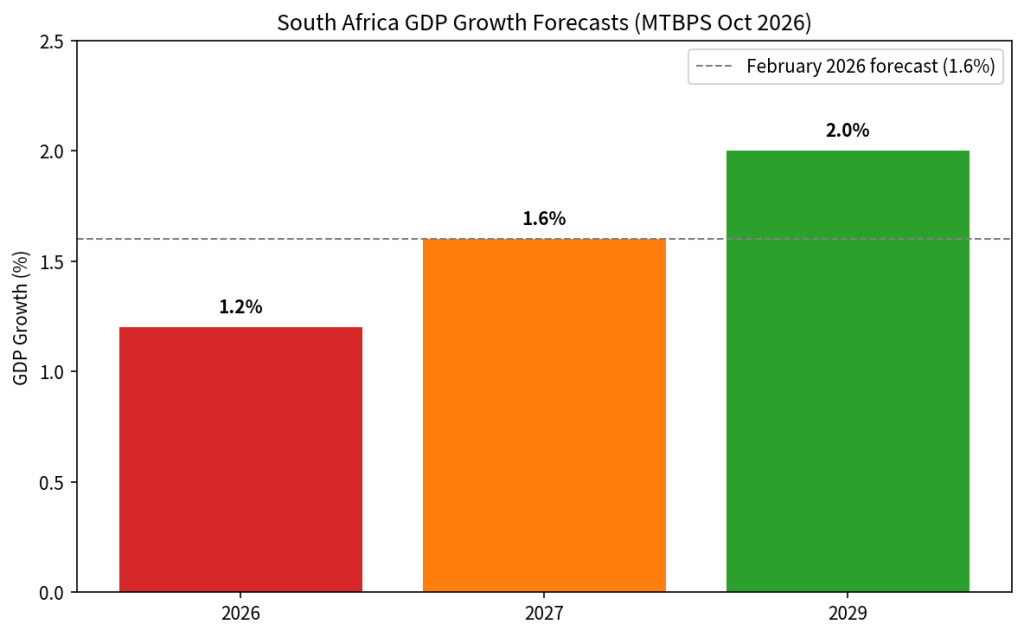
In his Medium-Term Budget Policy Statement on 21 October, Godongwana said the economy would grow by 1.2% this year, down from the 1.6% projected in February. He attributed the downgrade to the conflict in the Middle East. After the United States and Israel attacked Iran, the Strait of Hormuz was closed, pushing up oil, food and energy prices and raising borrowing costs. Treasury expects growth to recover to 1.6% in 2027 and 2% by 2029.
Despite the weaker outlook, Treasury said debt stabilised at 78.4% of GDP in 2025/26, the first time it has done so in almost two decades, and has begun to fall. The deficit is now expected at 4.3% of GDP this year, better than the 4.5% forecast in February, and is projected to shrink to 2.5% by 2030.
| Indicator | Figure |
|---|---|
| 2026 growth forecast | 1.2% (February: 1.6%) |
| 2026/27 deficit | 4.3% of GDP (February: 4.5%) |
| Debt-to-GDP, 2025/26 | 78.4% |
| Primary surplus | 1.7% of GDP, rising to nearly 3% by 2030 |
| Tax revenue revision, 2026/27 | Up R17.1bn |
| New savings over the medium term | R38.1bn |
Revenue is running ahead of plan. Gross tax collections for 2026/27 have been revised up by R17.1 billion on stronger corporate income tax, dividends tax and VAT. Treasury cautioned that much of the gain comes from higher commodity prices and is likely to fade. It still projects gross tax revenue rising from R2.14 trillion this year to R2.53 trillion in 2029/30.
The extra room has allowed the government to raise spending by R45.5 billion compared with February and to fund temporary relief at the pump. From 4 November, the date of the local government elections, the fuel levy will be cut by R3 a litre for diesel and R1.50 for petrol until 1 December. Smaller cuts of R1.50 and R1 will then apply until 5 January 2027. The R10 billion cost will be covered by funds previously transferred to the Central Energy Fund.
Spending restraint continues. Treasury identified R38.1 billion in further savings, including R13 billion from tackling social grant fraud and R7.8 billion from the human settlements development grant. Consolidated spending will rise by 3.6% a year to R3 trillion by 2029/30. Capital spending is the fastest-growing item, at 5.3% a year.
The statement also proposed new fiscal guardrails. Draft fiscal anchor legislation, released in October and due before Parliament in 2027, would not set a fixed numerical rule. Instead, it would require each administration to set its own fiscal targets and explain any deviations, with the Financial and Fiscal Commission reporting independently on compliance. Treasury has also published the first comprehensive revisions of the Public Finance Management Act and the Municipal Finance Management Act for public comment.
Municipal discipline is being tightened alongside extra funding. Treasury suspended equitable share transfers to 69 municipalities in June over unpaid creditors. Since then, 37 have agreed repayment plans and R4.2 billion has been paid. Local government will receive 10% of non-interest spending over the medium term.
The fiscal improvement has been noted by ratings agencies. Fitch upgraded South Africa to BB in June, its first sovereign upgrade in nearly 21 years, leaving the country two notches below investment grade. Godongwana said all three major agencies took positive rating actions this year.
Monetary conditions, however, have tightened. The Reserve Bank raised the repo rate by 25 basis points to 7.25% in September, citing upside risks to inflation. Consumer inflation stood at 4.4% in August.