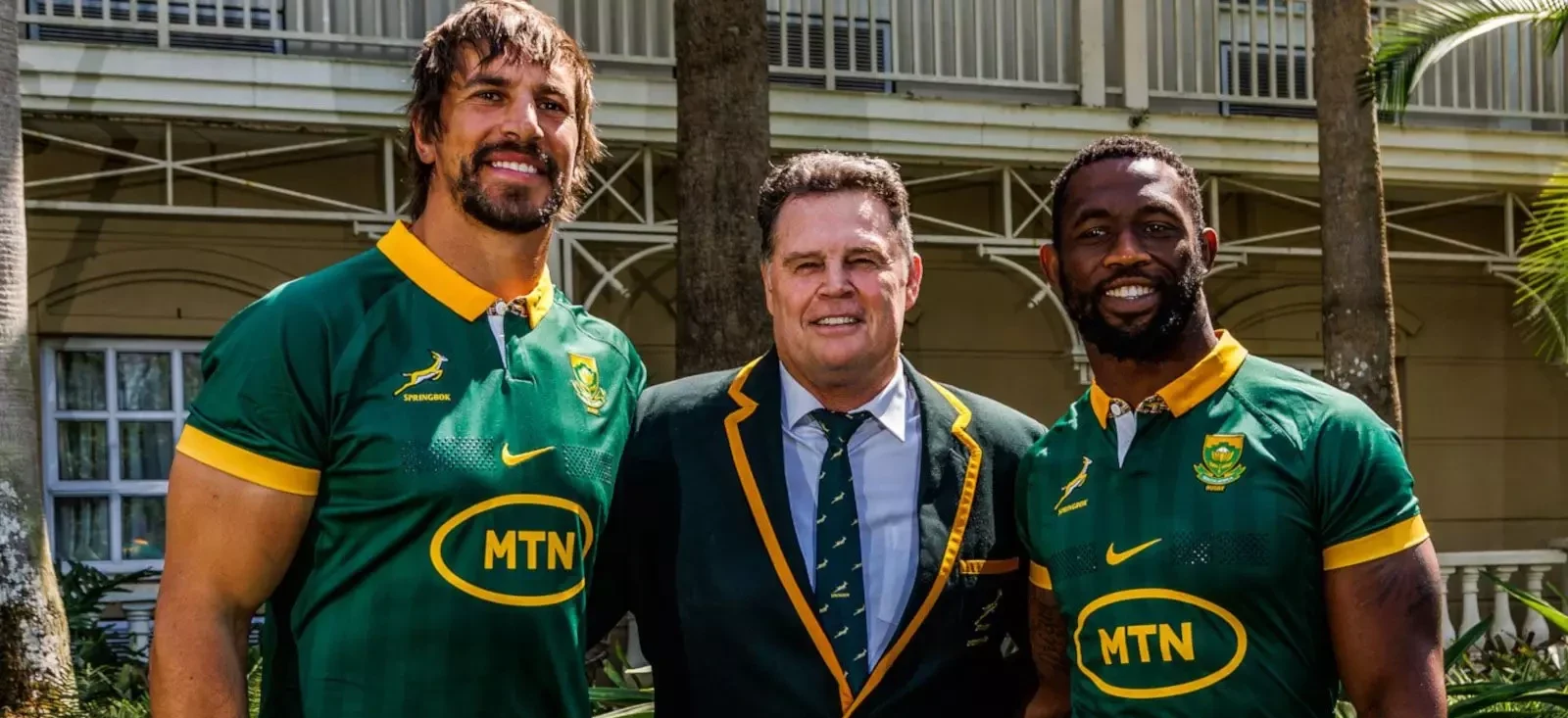
Business Explainer sat down with Stephen Berwick, Director of International Sports Investments — the company that has held the commercial rights to Barbarian international matches since 1998 — ahead of the highly anticipated clash between the world champion Springboks and the Barbarian FC at Nelson Mandela Bay Stadium in Gqeberha on 20 June 2026.
For a club that has no clubhouse, no stadium, and no permanent squad, the Barbarian FC has built one of rugby’s most enduring and commercially resilient brands. Since 1890, the invitational side has drawn players from every corner of the globe, played in countries that rarely host international rugby, and maintained a commercial operation that has outlasted empires, wars, and a global pandemic. The man responsible for the business architecture behind its international matches is Stephen Berwick, whose company International Sports Investments has been the Barbarians’ commercial partner for nearly three decades.
Berwick was direct about what makes the Barbarians a compelling commercial proposition. Unlike the British and Irish Lions — the closest comparable entity in terms of investment appeal — the Barbarians are an independent club, free to play not only across the United Kingdom but worldwide. That freedom, he explained, is both the source of the club’s commercial strength and the origin of its most persistent challenges.
READ – 23 South Africans to Join Springbok History
The revenue model is straightforward in structure if demanding in execution. Income flows from four primary sources: ticket sales, broadcast rights, sponsorship, and hospitality, with merchandise providing an additional stream. Berwick noted that ticket revenue tends to represent the largest single component, given the volume of seats involved. On the expenditure side, the costs are considerable — player fees, team hotels, international flights, marketing, management, referee fees, and payments to the participating unions all form part of the picture. “It’s the usual stuff, really,” he said. “Nothing too surprising.”
The decision to take the fixture to Gqeberha rather than Johannesburg, Cape Town, or Durban was a deliberate one, and Berwick was candid about the commercial logic behind it. The Barbarians had never previously played in the Eastern Cape — and that novelty alone carries value for a club that actively seeks new markets. The quality of Nelson Mandela Bay Stadium satisfied a non-negotiable requirement. And with test matches scheduled for Johannesburg and Cape Town in July, Gqeberha offered a less crowded commercial window.
There was also a human dimension that Berwick acknowledged without hesitation: Siya Kolisi, the Springbok captain, is from the Eastern Cape. “I don’t know how many more times he’s going to play there,” Berwick said. “He’s a remarkable individual who seems to have incredible longevity. But there comes a time. It’s a great opportunity for the local fans to see him.”
The fixture also arrives at a significant moment for the Springboks. With the Nations Championship opener against England on the horizon, head coach Rassie Erasmus has a rare opportunity to test combinations and blood new players in a competitive environment that carries consequence without the full weight of a test series. Berwick observed that the Barbarians format creates an unusual psychological space for players on both sides — the visitors playing without the fear of professional consequences, the hosts using the occasion as a genuine proving ground.
On the broadcast and sponsorship front, Berwick spoke warmly of SuperSport’s long-standing relationship with the Barbarians in South Africa, and noted YesPlay as the headline commercial partner for the Gqeberha fixture. He acknowledged that the broadcast landscape is shifting — recent changes in SuperSport’s ownership have altered the dynamics — but framed adaptability as the defining quality of anyone who has survived three decades in international sports business. “You’re never quite sure,” he said. “Things are always changing. But it’s about adapting to the challenges that you face.”
READ – YesPlay Named Title Sponsor for Springboks vs Barbarians Match
Asked about corporate social investment, Berwick pointed to the club’s charitable dimension — including significant annual contributions to the Atlas Foundation, which supports children living in extreme poverty across Africa and beyond — and noted that the Barbarians had been among the earliest international rugby organisations to establish a women’s team, ahead of the British and Irish Lions. A Barbarians women’s fixture at Twickenham is scheduled for later this month.
Looking ahead, Berwick’s five-year vision is one of continuity rather than reinvention: two to three major international fixtures per year, maintained relationships with tier one rugby nations, and a continued commitment to playing in non-traditional markets — Brazil, Czechia, Belgium — that no other international team regularly visits. “Our vision is to continue to thrive commercially and to have good relations with rugby partners,” he said. “And to entertain. That’s also the objective. To entertain, and for people to love the club.”
The Barbarians versus the Springboks kicks off in Gqeberha on 20 June 2026.