
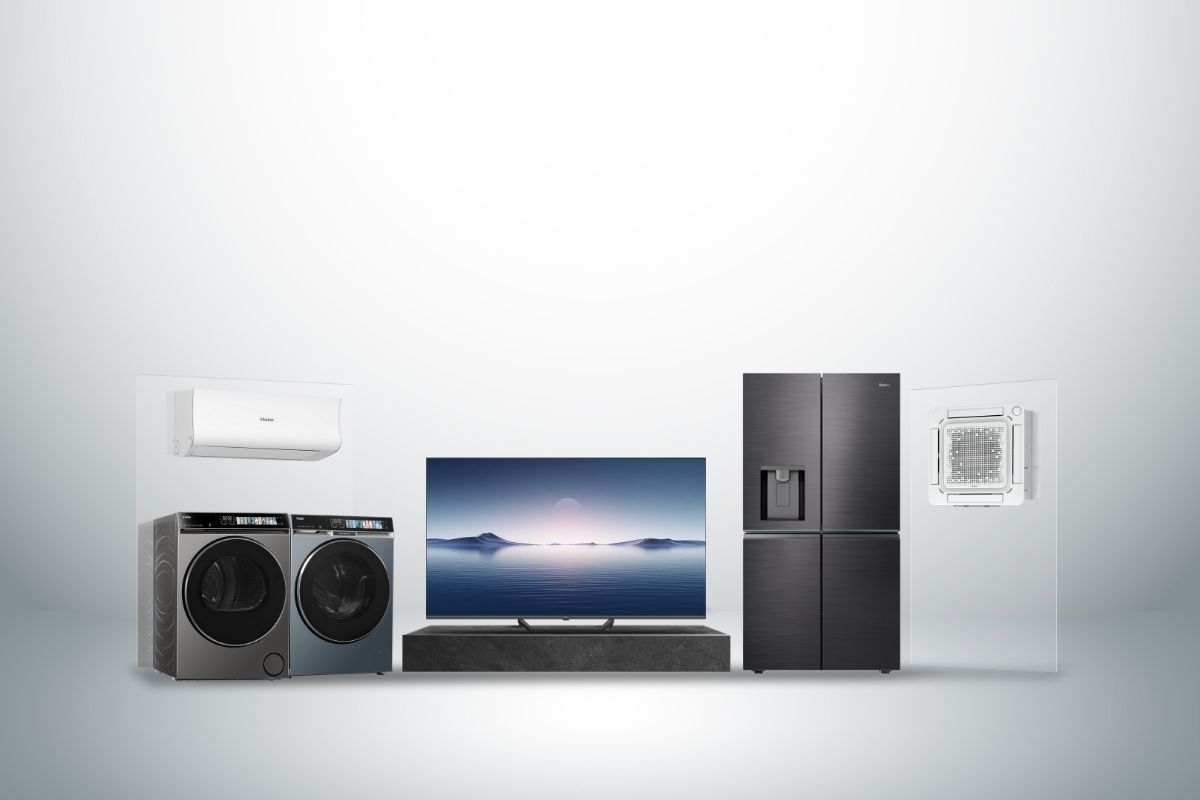
South African consumers are set to gain access to products from one of the world’s largest appliance manufacturers as Haier prepares for its official launch in the country. The Chinese multinational has invited government representatives and media to a launch event scheduled for 2 February 2026, where it will outline its global strategy, local investment plans and product range for the domestic market.
Haier enters South Africa with significant global scale. The company has ranked as the world’s largest manufacturer of major home appliances by retail volume for 16 consecutive years up to 2024. The group was valued at approximately ¥246.82 billion, equivalent to about R581.14 billion, in early January 2025. It employs more than 130,000 people and distributes products across over 200 countries and regions, positioning it among the most internationally diversified appliance brands.
Founded in 1984 as Qingdao Refrigerator Company, the firm’s origins trace back to the 1920s. After becoming a state-owned enterprise in 1949, the factory faced mounting financial strain by the early 1980s, with debt exceeding 1.4 million yuan and deteriorating production standards. A restructuring led by then city official Zhang Ruimin marked a turning point. His emphasis on strict quality control and modern management practices, coupled with a symbolic destruction of defective units, became central to the company’s corporate identity.
A joint venture with Germany’s Liebherr in 1984 proved decisive. The partnership upgraded production equipment and processes, returning the company to profitability by 1986. The name “Haier” derives from the final syllables of the Chinese transliteration of Liebherr. Over the following decade, Haier expanded through acquisitions within Qingdao and diversified its product range.
Between 1984 and 2000, revenue rose from ¥3.5 million to ¥40.5 billion, reflecting rapid domestic expansion and early export growth. The company began targeting overseas markets in the late 1990s and became the first Chinese manufacturer in its sector to secure ISO 9001 certification. In its 2025 interim results, Haier Smart Home reported revenue of ¥156.49 billion and net profit attributable to shareholders of ¥12.03 billion, equivalent to roughly R28.33 billion.
Haier’s global footprint has been strengthened by acquisitions, including GE Appliances in the United States, Fisher & Paykel in New Zealand, Candy in Italy and Hoover in Europe. According to Haier Smart Home’s 2024 Annual Report, the group has focused on integrating research and development, procurement and supply chain operations across its portfolio to drive efficiency and expand distribution channels.
In South Africa, Haier has already established a presence through its R2.45 billion acquisition of Kwikot, the country’s largest geyser manufacturer, from Electrolux in December 2024. The company indicated that the transaction would enhance Kwikot’s competitiveness through operational synergies and support its global ambitions in the water heater and purification segments. The deal also provides Haier with access to established local distribution networks, which could facilitate the rollout of its broader appliance and electronics range.
The South African appliance market is competitive, with established brands such as Hisense, Bosch, Defy, LG and Samsung maintaining strong retail positions. Industry data shows steady demand in categories including refrigeration, laundry appliances and air conditioning, supported by urbanisation and housing development, although constrained consumer spending remains a factor.
Haier’s product portfolio extends beyond core appliances to include televisions, mobile devices and gaming computers, reflecting its evolution into a diversified electronics manufacturer. Its entry into South Africa signals an intensification of competition in both mid-range and premium segments, as global manufacturers seek growth in emerging markets amid slower expansion in developed economies.